
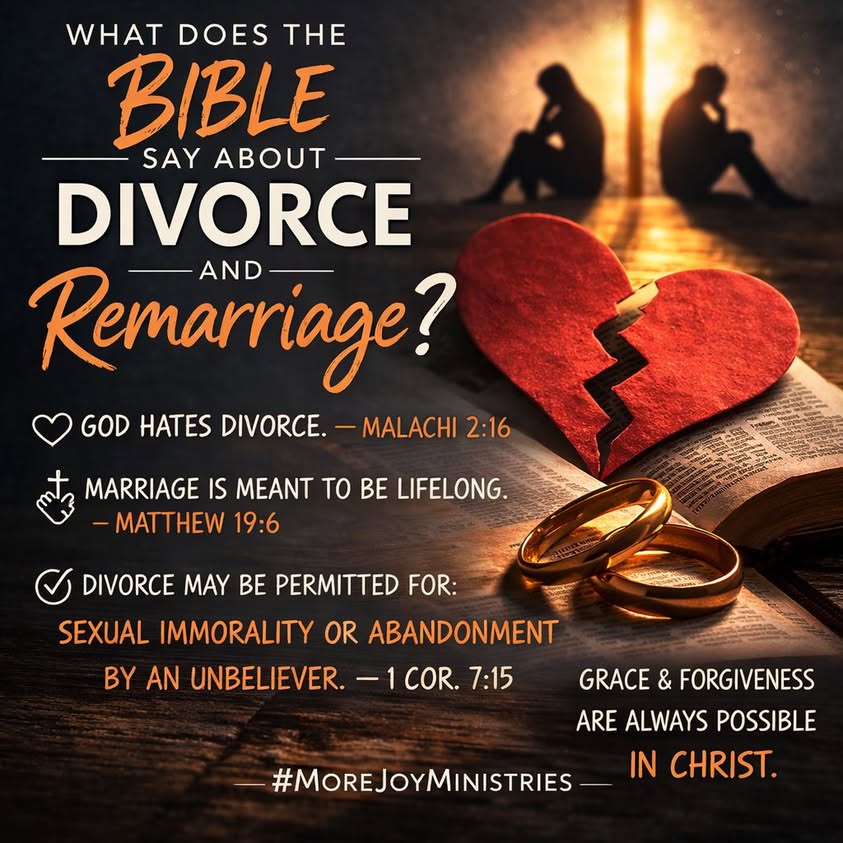
Tony Campbell added a new photo to the album: The Most Frequently Asked Bible Questions:.
The Most Frequently Asked Bible Questions:WHAT DOES THE BIBLE SAY ABOUT DIVORCE AND REMARRIAGE? Few topics generate more debate among Christians than divorce and remarriage. Emotions run high because
The Most Frequently Asked Bible Questions:WHAT DOES THE BIBLE SAY ABOUT DIVORCE AND REMARRIAGE?
Few topics generate more debate among Christians than divorce and remarriage. Emotions run high because marriage touches the deepest parts of human life: covenant, trust, family, and faithfulness. When we approach the issue, we must begin where Scripture begins.
God’s design for marriage was never temporary.
From the beginning, marriage was intended to be a lifelong covenant between one man and one woman. Jesus quotes Genesis when He explains God’s original design:
“So they are no longer two, but one flesh. Therefore what God has joined together, let no man separate.” Matthew 19:6
Marriage is not merely a contract between two people. It is a covenant established before God. When a man and woman are joined together, Scripture says they become “one flesh.” That union is meant to reflect faithfulness, permanence, and devotion.
Because of that, God speaks very strongly about divorce.
Malachi 2:16 records the Lord saying:
“I hate divorce.”
That statement often sounds harsh, but it reveals something important about God’s heart. Divorce tears apart something sacred. It fractures families, wounds hearts, and breaks a covenant that was meant to last a lifetime.
However, the Bible also acknowledges the reality of human sin.
God understands that marriages involve two imperfect people. Because of human rebellion and hardness of heart, marriages sometimes collapse. When Jesus addressed the issue, He explained that the divorce laws in the Old Testament were never God’s ideal but a concession to human brokenness.
“Moses permitted you to divorce your wives because your hearts were hard. But it was not this way from the beginning.” Matthew 19:8
In other words, divorce exists because sin exists. It is not God’s original design, but Scripture recognizes that it will occur.
The Apostle Paul addresses divorce among believers directly in 1 Corinthians 7.
“To the married I give this command (not I, but the Lord): A wife must not separate from her husband. But if she does, she must remain unmarried or else be reconciled to her husband. And a husband must not divorce his wife.” 1 Corinthians 7:10–11
Paul restates the same foundational principle Jesus taught. Marriage should not be broken. If separation occurs, reconciliation should be the goal. If reconciliation is not possible, the instruction is to remain unmarried.
This establishes the biblical baseline: Marriage is meant to be permanent, and divorce is not God’s desire.
Yet Scripture also presents two situations where divorce may be permitted.
The first is sexual immorality.
Jesus states this exception clearly in both Matthew 5:32 and Matthew 19:9.
“Whoever divorces his wife, except for sexual immorality, and marries another commits adultery.” Matthew 19:9
The Greek word used here is πορνεία (porneia). It is a broad term referring to sexual immorality of many kinds: adultery, fornication, prostitution, or other forms of sexual sin.
Sexual relations are central to the “one flesh” bond of marriage. When that bond is violated through adultery, the covenant itself has been broken. Many interpreters understand Jesus to be saying that sexual immorality can dissolve the marriage covenant and make divorce permissible.
It is important to notice that Jesus presents this as an allowance, not a command. Even when adultery occurs, forgiveness and reconciliation are still possible through repentance and grace.
The second possible exception is abandonment by an unbelieving spouse.
Paul discusses this situation in 1 Corinthians 7:15.
“If the unbeliever departs, let him depart. A brother or a sister is not under bondage in such cases; God has called us to peace.”
Here Paul describes a marriage between a believer and an unbeliever where the unbelieving spouse chooses to leave. In that situation, the believing spouse is “not bound.” Many scholars understand this phrase to mean the believer is no longer obligated to maintain the marriage covenant if the unbeliever abandons it.
In this case, the believer is the innocent party. The marriage has been broken by desertion, not by their choice.
Because of this language, many interpreters conclude that remarriage may be permissible for the abandoned believer.
Another issue sometimes raised is abuse. Scripture does not explicitly list abuse as a ground for divorce. However, protecting life and safety is always biblical wisdom. In situations of abuse, immediate separation is necessary for protection. Pastoral guidance and careful discernment are essential in such circumstances.
Something often overlooked in these debates is that divorce is never presented in Scripture as something to pursue quickly. Even when biblical grounds exist, reconciliation remains the first hope.
The gospel itself teaches forgiveness.
“Be kind and compassionate to one another, forgiving each other, just as in Christ God forgave you.” Ephesians 4:32
If r