
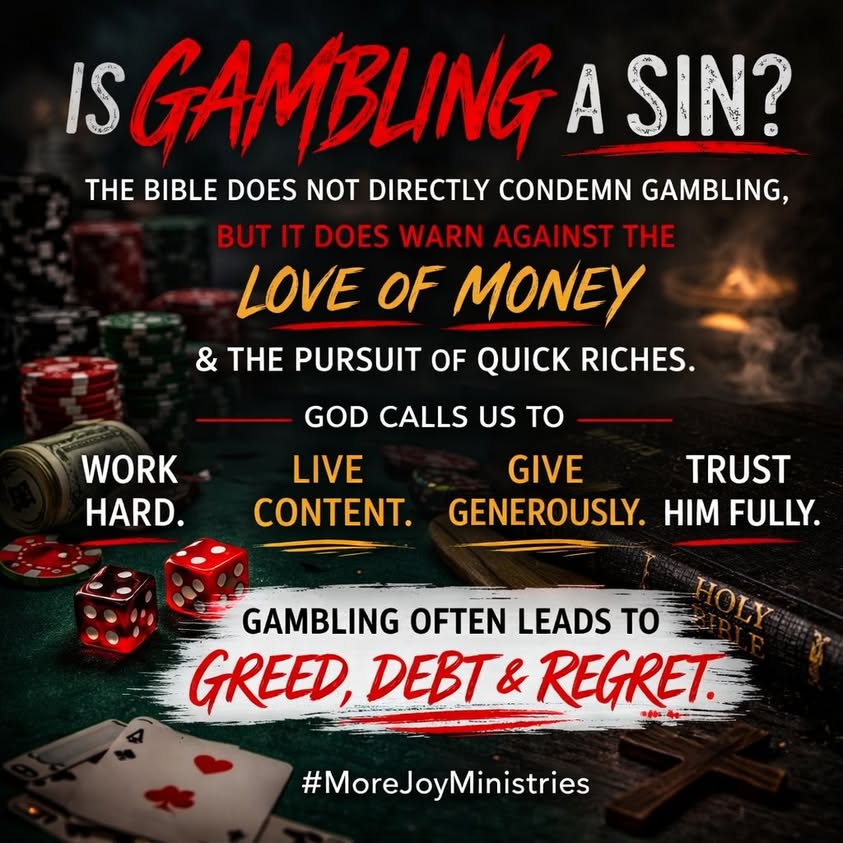
Tony Campbell added a new photo to the album: The Most Frequently Asked Bible Questions:.
The Most Frequently Asked Bible Questions:Is Gambling a Sin? The Bible does not explicitly say, “You shall not gamble.” You will not find a verse that directly mentions casinos, lotteries, poker tabl
The Most Frequently Asked Bible Questions:Is Gambling a Sin?
The Bible does not explicitly say, “You shall not gamble.” You will not find a verse that directly mentions casinos, lotteries, poker tables, or sports betting. But that does not mean Scripture is silent on the principles involved.
The issue is not the activity alone. The issue is the heart behind it.
First, Scripture consistently warns about the love of money. In First Epistle to Timothy 6:10, Paul writes that the love of money is a root of all kinds of evil. Notice carefully..money itself is not the root. The love of it is. Gambling is built on the desire to gain more money with minimal effort. It feeds the craving for quick increase without proportional labor.
Hebrews 13:5 tells believers to keep their lives free from the love of money and to be content with what they have. Gambling thrives on discontent. It whispers, “What you have is not enough. You need more. And you can get it fast.”
That mindset directly conflicts with biblical contentment.
Second, Scripture consistently upholds honest work. In Second Epistle to the Thessalonians 3:10, Paul states plainly that if a man will not work, he shall not eat. Proverbs 14:23 reinforces the principle that all hard work brings profit. Gambling attempts to bypass this pattern. It seeks gain detached from productive labor. Biblically, provision is tied to diligence, stewardship, and faithfulness, not chance.
Some point to “casting lots” in Scripture as justification. It is true that lots were cast in the Old Testament and even in Acts of the Apostles 1:26 when the apostles chose a replacement for Judas. But those events were not gambling. No one wagered money. No one profited from another’s loss. Casting lots was a method of discerning God’s will in specific covenantal contexts, not a model for games of chance for personal gain. Proverbs 16:33 reminds us that the lot’s decision is from the Lord, but that verse affirms God’s sovereignty, not human betting.
There is also an ethical dimension many ignore.
Gambling, by design, requires loss. For someone to win, others must lose. In casinos, the system is mathematically structured so that the house always profits long term. State lotteries function the same way. They are often marketed as funding education or public programs, yet studies consistently show that lower-income households spend a significantly higher percentage of their income on lottery tickets than wealthier households. In practical terms, the system often extracts money from those who can least afford to lose it.
That raises serious stewardship concerns.
A believer is called to manage resources as something entrusted by God. Money is not merely personal property; it is stewardship capital. Wasting resources on activities engineered for loss does not reflect wisdom. Yes, people waste money on many things..entertainment, luxury meals, impulse purchases. But pointing to other waste does not justify adding another category of it.
Then there is the spiritual risk.
Casinos are intentionally designed environments. Alcohol lowers inhibition. Lights, sounds, and rewards trigger psychological responses. The entire structure aims to keep people spending beyond their original intention. Addiction is not rare in that environment. It destroys marriages, families, and financial stability. What begins as “harmless fun” can quietly become bondage.
Jesus made a foundational statement in Gospel of Matthew 6:24: you cannot serve both God and money. Gambling intensifies the pull toward serving money. It cultivates hope in chance instead of trust in provision.
So is gambling explicitly named as sin in Scripture? No.
But does it align with biblical stewardship, contentment, diligence, and love for others? No.
It encourages greed. It attempts to shortcut honest labor. It risks rejoicing in another’s loss. It often exploits the vulnerable. It feeds discontent rather than gratitude.
For a Christian seeking to honor God, the wiser question is not, “Can I get away with it?” The wiser question is, “Does this reflect faithful stewardship and a heart anchored in Christ?”
We are called to work diligently, give generously, live contentedly, and trust God for provision. Anything that undermines those foundations should be approached with serious caution.
- @[61583539981347:2048:More Joy Ministries]
#MoreJoyMinistriesIs Gambling a Sin? The Bible does not explicitly say, “You shall not gamble.” You will not find a verse that directly mentions casinos, lotteries, poker tables, or sports betting. But that does not mean Scripture is silent on the principles involved. The issue is not the activity alone. The issue is the heart behind it. First, Scripture consistently warns about the love of money. In First Epistle to Timothy 6:10, Paul writes that the love of money is a root of all kinds of evil. Notice carefully..money itself is not the root. The love of it is. Gambling is built on the desire to gain more