
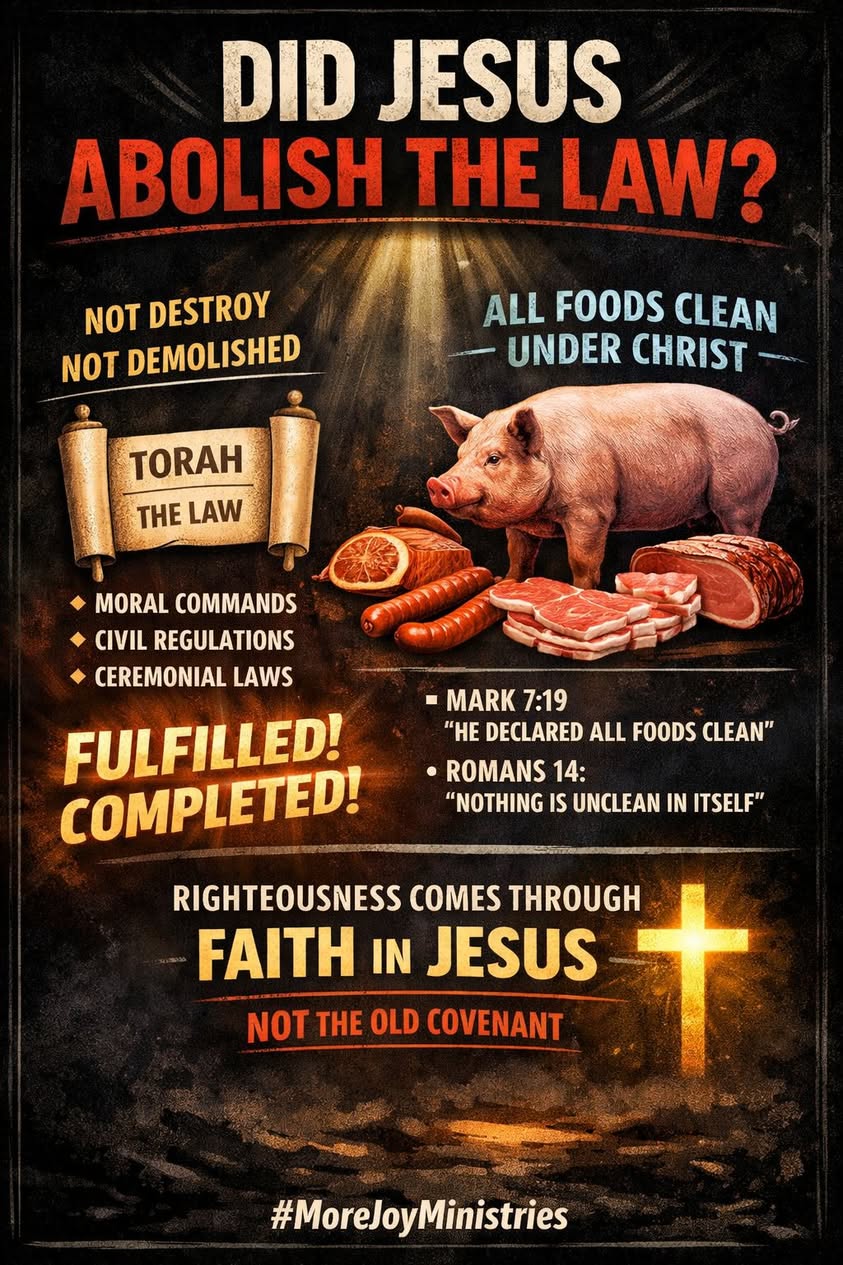
Tony Campbell added a new photo to the album: The Most Frequently Asked Bible Questions:.
The Most Frequently Asked Bible Questions:DID JESUS ABOLISH THE LAW, AND CAN I EAT BACON? People love to say, “Jesus fulfilled the Law, so it doesn’t matter anymore.” That’s usually said without expl
The Most Frequently Asked Bible Questions:DID JESUS ABOLISH THE LAW, AND CAN I EAT BACON?
People love to say, “Jesus fulfilled the Law, so it doesn’t matter anymore.” That’s usually said without explaining what fulfilled actually means.
In Matthew 5:17 Jesus says He did not come to destroy the Law but to fulfill it. The Greek word for destroy is katalyō. It means tear down or demolish. The word for fulfill is plēroō. It means bring to completion. Bring to its intended goal.
The Hebrew word for Law is Torah. It means instruction. It wasn’t just random rules. It was a covenant God made with Israel at Sinai in Exodus 19. That covenant included moral commands, civil law for the nation of Israel, and ceremonial regulations like sacrifices, priesthood, and dietary distinctions.
The dietary laws in Leviticus 11 call certain animals ṭāmēʾ. That Hebrew word means ceremonially unclean. It does not mean morally evil. It means not fit within Israel’s covenant system.
The Law had a purpose. Paul explains it in Galatians 3. He calls it a paidagōgos. That was a guardian assigned to supervise a child until maturity. Once maturity came, the guardian stepped aside. The Law revealed sin. It never justified anyone. Romans 3:20 says no one is justified by works of the Law.
The sacrificial system pointed forward to Christ. Hebrews 10 says the Law was a shadow. The Greek word is skia. A shadow points to something real. Jesus is the reality. When the priesthood changed, Hebrews 7 says there was a metathesis, a transfer, a change in the law connected to it.
That’s fulfillment. Not destruction. Completion.
Jesus even addressed food directly. In Mark 7 the text says He declared all foods clean. Paul later says in Romans 14 that nothing is unclean in itself. In Acts 15 the apostles made it clear Gentiles were not placed under the Law of Moses.
So biblically, a Christian can eat pork. It is not sin under the New Covenant.
Ironically the only time demons asked Jesus for a place to live in the Bible, they chose pigs.
The pigs immediately ran off a cliff.
Now here’s my position.
I don’t eat pork.
Not because I think it earns righteousness. Christ alone is my righteousness. Not because I think I’m more spiritual. That would contradict Galatians entirely.
I don’t eat it because pigs are omnivorous scavengers. They will consume almost anything. Pork can carry parasites like trichinella if improperly prepared. Yes, modern standards reduce that risk. But that doesn’t change the nature of the animal.
Then look at processed pork. Hot dogs, bacon, sausage. Highly processed meats loaded with nitrates and preservatives. Medical literature has repeatedly linked high consumption of processed meats with increased colorectal cancer risk and cardiovascular disease. This is epidemiology.
When Leviticus calls the pig ṭāmēʾ, it is speaking covenant language. Science doesn’t use that word, but it does recognize that pork and especially processed pork products come with legitimate health concerns.
So I abstain.
That’s just me. It's not salvation.
If someone eats pork, they are not defiled before God. If someone abstains, they are not earning favor before God.
The Law was not demolished. It was completed. The covenant structure changed. Justification is by faith. The Spirit writes the law on the heart as promised in Jeremiah 31.
The issue isn’t bacon.
The issue is whether you think righteousness comes from Christ or from Sinai.
That’s where the line is.
- @[61583539981347:2048:More Joy Ministries]
#MoreJoyMinistriesDID JESUS ABOLISH THE LAW, AND CAN I EAT BACON? People love to say, “Jesus fulfilled the Law, so it doesn’t matter anymore.” That’s usually said without explaining what fulfilled actually means. In Matthew 5:17 Jesus says He did not come to destroy the Law but to fulfill it. The Greek word for destroy is katalyō. It means tear down or demolish. The word for fulfill is plēroō. It means bring to completion. Bring to its intended goal. The Hebrew word for Law is Torah. It means instruction. It wasn’t just random rules. It was a covenant God made with Israel at Sinai in Exodus 19. That covenant included moral commands, civil law for the nation of Israel, and ceremonial regulations like sacrifices, priesthood, and dietary distinctions. The dietary laws in Leviticus 11 call certain animals ṭāmēʾ. That Hebrew word means ceremonially unclean. It does not mean morally evil. It means not fit within Israel’s covenant system. The Law had a purpose. Paul explains it in Galatians 3. He calls it a paidagōgos. That was a guardian assigned to supervise a child until maturity. Once maturity came, the guardian stepped aside. The Law revealed sin. It never justified anyone. Romans 3:20 says no one is justified by works of the Law. The sacrificial system pointed forward to Christ. Hebrews 10 says the Law was a shadow. The Greek word is skia. A shadow points to something real. Jesus is the reality. When the priesthood changed, Hebrews 7