
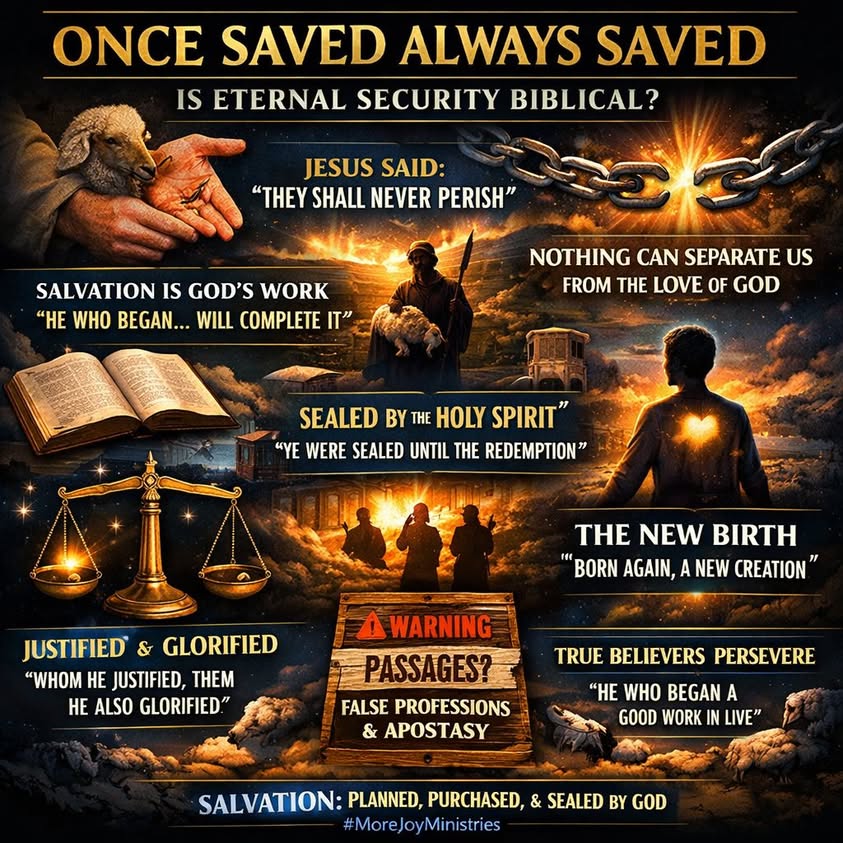
Tony Campbell added a new photo to the album: The Gospel.
The GospelONCE SAVED ALWAYS SAVED: IS ETERNAL SECURITY BIBLICAL? This is one of the most debated doctrines in Christianity. It is often summarized in the phrase “once saved always saved.” Some accept
The GospelONCE SAVED ALWAYS SAVED: IS ETERNAL SECURITY BIBLICAL?
This is one of the most debated doctrines in Christianity. It is often summarized in the phrase “once saved always saved.” Some accept it. Some strongly reject it. Because of how serious salvation is, this subject cannot be handled with slogans, denominational traditions, or emotional arguments. It must be examined carefully through Scripture.
Before diving into the biblical evidence, we must first define what the doctrine actually means, because it is often misunderstood.
“Once saved always saved” does NOT mean that a person can pray a prayer, live in rebellion, deny Christ, and still be secure. It does not mean salvation is a license to sin. It does not mean obedience, transformation, or perseverance do not matter.
Biblically, eternal security means that if a person is genuinely regenerated by God, born again, justified by Christ, and sealed by the Holy Spirit, their salvation cannot be undone because it rests on God’s work, not human performance.
SALVATION IS GOD’S WORK FROM BEGINNING TO END:
Ephesians 2:8–9 says: “For by grace are ye saved through faith; and that not of yourselves: it is the gift of God: Not of works, lest any man should boast.”
Scripture teaches that salvation is not initiated by human effort and is not sustained by human works. If salvation originates entirely as a gift from God, then it cannot be lost because of human failure. Otherwise, salvation would ultimately depend on human stability rather than divine grace.
Philippians 1:6 says: “Being confident of this very thing, that he which hath begun a good work in you will perform it until the day of Jesus Christ.”
God begins the work of salvation. God completes the work of salvation. The verse does not present this as a possibility or a conditional outcome. It is stated as a confident assurance rooted in God’s faithfulness.
If salvation could be lost, this promise would depend on human consistency rather than God’s commitment.
JESUS DECLARES THAT HIS SHEEP CANNOT BE LOST:
John 10:27–29 records Jesus saying: “My sheep hear my voice, and I know them, and they follow me: And I give unto them eternal life; and they shall never perish, neither shall any man pluck them out of my hand. My Father, which gave them me, is greater than all; and no man is able to pluck them out of my Father’s hand.”
Jesus gives eternal life to His sheep. Eternal life is not temporary life. If it can be lost, it was never eternal.
Jesus also makes a double security statement. Believers are held in His hand and in the Father’s hand. The Greek wording used here is emphatic, meaning they shall never, ever perish. There is no conditional clause attached to this promise.
If someone who truly belongs to Christ can ultimately perish, then Christ’s statement would be incorrect. Scripture does not allow that conclusion.
THE SEAL OF THE HOLY SPIRIT GUARANTEES INHERITANCE:
Ephesians 1:13–14 says: “In whom ye also trusted, after that ye heard the word of truth, the gospel of your salvation: in whom also after that ye believed, ye were sealed with that holy Spirit of promise, Which is the earnest of our inheritance until the redemption of the purchased possession.”
The word “sealed” comes from the Greek word sphragizō. In the ancient world, a seal represented ownership, security, and authenticity. It marked something as belonging to the one who sealed it and protected it from tampering.
The Holy Spirit is also described as the “earnest” of our inheritance. The Greek word arrabōn means a deposit or down payment that guarantees full payment later.
If a believer can lose salvation, then God’s seal can be broken and His guarantee can fail. Scripture presents the opposite. The Spirit is given until final redemption is completed.
JUSTIFICATION IS A LEGAL DECLARATION THAT CANNOT BE REVERSED:
Romans 8:30 says: “Moreover whom he did predestinate, them he also called: and whom he called, them he also justified: and whom he justified, them he also glorified.”
This verse presents what theologians often call the unbreakable chain of redemption. Everyone who is justified is also ultimately glorified. Notice that glorification, which is still future from a human perspective, is spoken of in the past tense. This demonstrates the certainty of God’s saving plan.
If someone could be justified and later lost, this chain would be broken. Paul presents it as inseparable and guaranteed.
Romans 8:38–39 continues: “For I am persuaded, that neither death, nor life, nor angels, nor principalities, nor powers, nor things present, nor things to come… shall be able to separate us from the love of God, which is in Christ Jesus our Lord.”
Paul intentionally lists every possible category of threat. This includes present realities and future events. If future failure or personal weakness could separate believers from Christ, this passage would not stand as written.
THE NEW BIRTH IS IRREVERSIBLE:
John 3:3 records Jesus