
Tony Campbell added a new photo to the album: The Gospel.
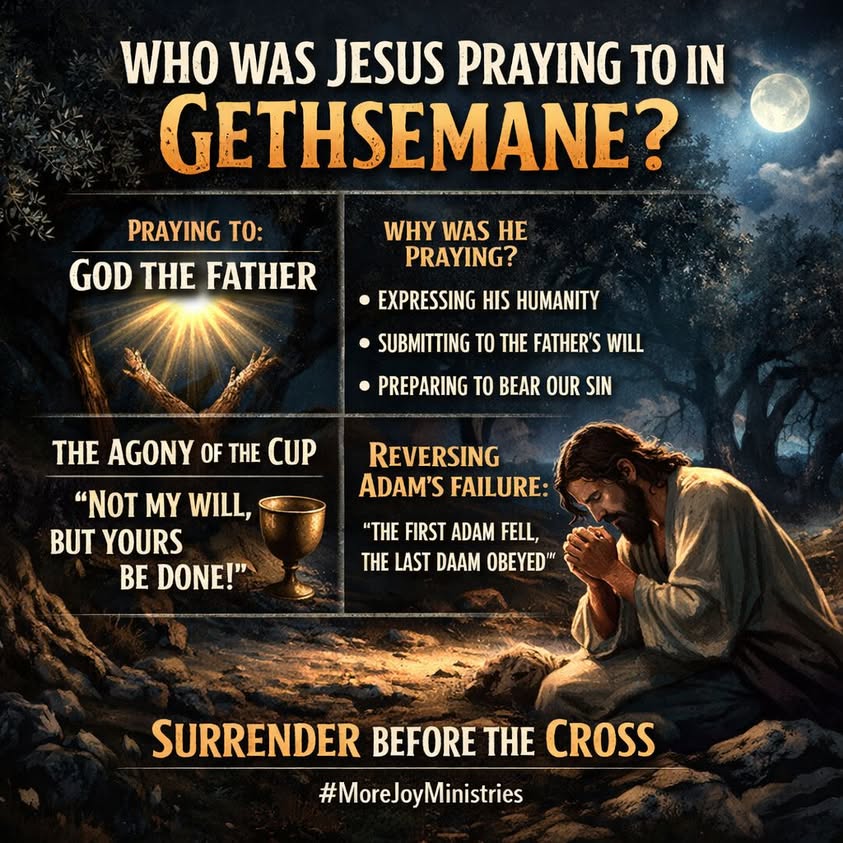
The GospelWHO WAS JESUS PRAYING TO IN GETHSEMANE: AND WHY DOES IT MATTER? One of the most emotional and revealing moments in all of Scripture happens in a quiet garden just hours before the crucifixi
The GospelWHO WAS JESUS PRAYING TO IN GETHSEMANE: AND WHY DOES IT MATTER?
One of the most emotional and revealing moments in all of Scripture happens in a quiet garden just hours before the crucifixion. It is here that we see Jesus fall to the ground and pray with such intensity that Scripture says His sweat became like drops of blood. This moment is not just historical. It reveals the heart of redemption itself.
THE SCENE: THE GARDEN OF GETHSEMANE
The name “Gethsemane” comes from the Hebrew words Gat Shemanim, meaning “Oil Press.” Olives were crushed there to produce oil. The symbolism is powerful. Before Jesus would become the Light of the world, He was spiritually pressed under the weight of what He was about to endure.
Matthew 26:39 tells us: “And he went a little farther, and fell on his face, and prayed, saying, O my Father, if it be possible, let this cup pass from me: nevertheless not as I will, but as thou wilt.”
WHO WAS JESUS PRAYING TO?
Jesus was praying to God the Father.
Throughout His earthly ministry, Jesus consistently spoke of the Father as distinct in person, yet fully united in divine nature. Gethsemane is one of the clearest moments where we see the relational reality within the Godhead. Christianity teaches one God revealed in three persons: Father, Son, and Holy Spirit. In Gethsemane, the Son is speaking directly to the Father.
This moment does not show division inside the Trinity. It shows relationship and mission. The Father sends. The Son redeems. The Spirit applies salvation to believers.
WHY WAS JESUS PRAYING?
JESUS WAS EXPRESSING HIS TRUE HUMANITY:
Jesus is fully God and fully man. Gethsemane reveals the depth of His human experience. He was about to face betrayal, torture, public humiliation, and crucifixion. But beyond physical suffering, He was about to carry the full weight of human sin.
Luke 22:44 says: “And being in an agony he prayed more earnestly: and his sweat was as it were great drops of blood falling down to the ground.”
Medical science even recognizes a rare condition called hematidrosis, where extreme stress can cause blood vessels to rupture into sweat glands. Scripture records Jesus experiencing agony beyond normal human stress.
This was not symbolic suffering. This was real dread at the cost of redemption.
JESUS WAS SUBMITTING TO THE FATHER’S WILL:
The most important line in the prayer is: “Not my will, but thine be done.”
The Greek word for will here is thelēma, meaning desire, purpose, or determination. Jesus, in His humanity, naturally recoiled from the suffering ahead. Yet He willingly submitted to the Father’s redemptive plan.
Philippians 2:8 explains: “And being found in fashion as a man, he humbled himself, and became obedient unto death, even the death of the cross.”
Gethsemane is obedience at its most intense level.
JESUS WAS PREPARING TO DRINK THE CUP OF JUDGMENT:
When Jesus asks if “this cup” could pass from Him, He is referencing a major Old Testament symbol. The cup repeatedly represents God’s judgment against sin.
Psalm 75:8 says: “For in the hand of the LORD there is a cup… and all the wicked of the earth shall wring them out, and drink them.”
Isaiah 51:17 describes the cup as the cup of God’s wrath.
Jesus was preparing to drink the judgment humanity deserved. He was not dying merely as a martyr. He was stepping forward as the sin-bearer.
2 Corinthians 5:21 explains this substitution: “For he hath made him to be sin for us, who knew no sin; that we might be made the righteousness of God in him.”
This is why the agony of Gethsemane is so severe. Jesus is not only anticipating physical death. He is preparing to absorb the full judicial penalty of sin.
JESUS WAS MODELING TRUE PRAYER
Gethsemane teaches believers how to approach God honestly.
Jesus did not hide His sorrow. He expressed His desire openly. Yet He surrendered His outcome to the Father’s will.
Biblical prayer is not forcing God to agree with us. It is aligning our hearts with His plan, even when that plan is difficult.
JESUS WAS REVERSING ADAM’S FAILURE:
There is a profound biblical parallel happening here. The first Adam faced temptation in a garden and chose disobedience, bringing sin into the world. The last Adam, Jesus Christ, faced crushing pressure in a garden and chose obedience, bringing redemption to the world.
Romans 5:19 says: “For as by one man’s disobedience many were made sinners, so by the obedience of one shall many be made righteous.”
The garden of Gethsemane is the turning point where the curse of Eden begins to be undone.
THE SLEEPING DISCIPLES:
While Jesus prayed, His disciples repeatedly fell asleep. This highlights the weakness of human flesh compared to the faithfulness of Christ. Jesus even warns them:
“The spirit indeed is willing, but the flesh is weak.” Matthew 26:41
Salvation does not depend on human strength. It depends on Christ’s obedience.
WHY GETHSEMANE MATTERS TODAY:
Gethsemane proves that Jesus willingly chose the c