
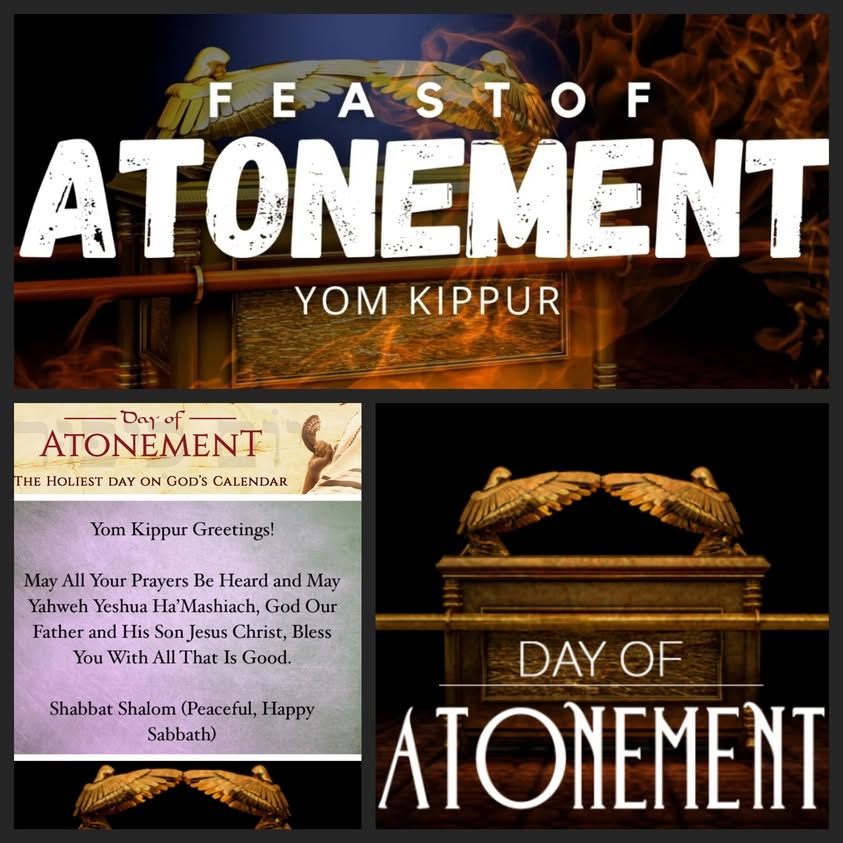
Tony Campbell added a new photo to the album: The Feasts .
The Feasts What Is the Day of Atonement? Lisa Loraine Baker Author of Someplace to Be Somebody The centrality of Old Testament worship focused on sacrifice. When the Lord God instituted the office o
The Feasts What Is the Day of Atonement?
Lisa Loraine Baker Author of Someplace to Be Somebody
The centrality of Old Testament worship focused on sacrifice. When the Lord God instituted the office of priest (Exodus 29; Leviticus 8:1-36), He gave many specific instructions to the priests to atone for the sins of His people. The Lord God also gave detailed instructions as to which animals were presented for sacrifice, and how. To understand the Day of Atonement is to understand the Old Testament sacrificial system.
What Is the Day of Atonement? Atonement, in its purest sense means to be “at one,” or, right with God, with no enmity or division. After the Lord God established the Levitical priesthood stemming from Aaron, Aaron’s two sons, Nadab and Abihu offered unauthorized fire before the Lord. While the Bible does not give us details about their intentions, which may have seemed honorable (to themselves), they forsook God’s holiness by disobeying His detailed instructions, “And fire came out from before the LORD and consumed them, and they died before the LORD” (Leviticus 10:1-2).
Because of Nadab’s and Abihu’s transgression, Leviticus 16 begins with a reminder of what they had done and the difficulty it posed for the nation. Hence, God decreed to Moses the proper order and presentation of sacrifices before the LORD. As His means of dealing with the sins of the people, the LORD established the annual Day of Atonement for His people (Leviticus 16), and the day He chose is the tenth day of the seventh month (Tishri – September/October).
What Does the Bible Say Happened as Part of This Duty? The Day of Atonement was the only day Aaron (and subsequent priests) were permitted to enter the innermost part of God’s Tabernacle, wherein lay the Ark of the Covenant. The cover of the Ark is called the Mercy Seat or, Atonement seat. Bill Mounce explains, “Because he ‘lived’ there, the Most Holy Place had to be filled with a cloud of incense on the Day of Atonement, lest the high priest see him and die. All forgiveness and purging of sin, of course, is possible only because of the forgiving grace and mercy of God.”
The priest, before his annual entrance into the holy of holies, had to procure forgiveness and cleansing from his own sins. He then cleansed the Tabernacle and made the offering for the forgiveness of the peoples’ sins.
The procedure which follows is as such:
Most were similar to those followed for other sin offerings, except on the Day of Atonement, the blood of the sacrifices was also sprinkled on the Mercy Seat (Leviticus 16:14). The reason was to protect the people from God’s wrath because of the priest’s and the people’s accumulated sin.
The priest then had to toss incense in the air in front of them as they came near the ark of the covenant so they would be veiled from seeing the Lord (Leviticus 16:12-13). To see him would mean their immediate death (Exodus 33:12-23).
In addition to the sacrificial bull (to cover the priests), two goats were taken into the Tabernacle for the sins of the people (Leviticus 16:6-10). One goat was sacrificed and his blood was sprinkled on the mercy seat. God’s wrath was therefore satisfied via a substitute for the people (propitiation).
The priest then laid hands on the other goat and was sent to “Azazel in the wilderness,” and freed, carrying away the sins (or perhaps taken away from the people and the holy camp to a deserted mountain where it was killed (expiation).
Why Was This Observance So Important? Biblical theology writer Alastair Roberts, posits, “Yom Kippur, commonly translated as the Day of Atonement, was an appointed fast that occurred on the tenth day of the seventh month. Of all the days marked out in Leviticus 23, this was the high point. On the Day of Atonement, the entire sacrificial system was rebooted. After a year of accumulating sin and impurity, symbolically polluting the system and its ministers, the Day of Atonement cleanses and reestablishes the whole system.”
The sacrifices and offerings all pointed to Jesus Christ and His death on the cross as the final and ultimate sacrifice for man’s sins (for those who surrender to Him as Lord and Savior).
How Do We See Christ in These Rituals? Romans 3:25 uses the Greek term, hilastērion for Jesus as a “place of atonement.” Jesus is now in the place of the Old Testament’s mercy seat (seat of atonement). It’s in Christ God lives in the flesh (Incarnation), and God’s wrath is propitiated in Him (Romans 1:18). He is our bridge between God and us.
All the sacrificial animals represented the most precious possession of the one who offered the sacrifice. John 3:16 tells us, “God so loved the world He gave His one and only Son…” For God to sacrifice His most precious possession was to sacrifice Himself — wholly unblemished by sin (2 Corinthians 5:21; Hebrews 4:15; 1 Peter 1:18-19, 2:22; 1 John 3:5).
Exodus 12 shows us God required a lamb as one of the sacrificial offerings from the families who could a