
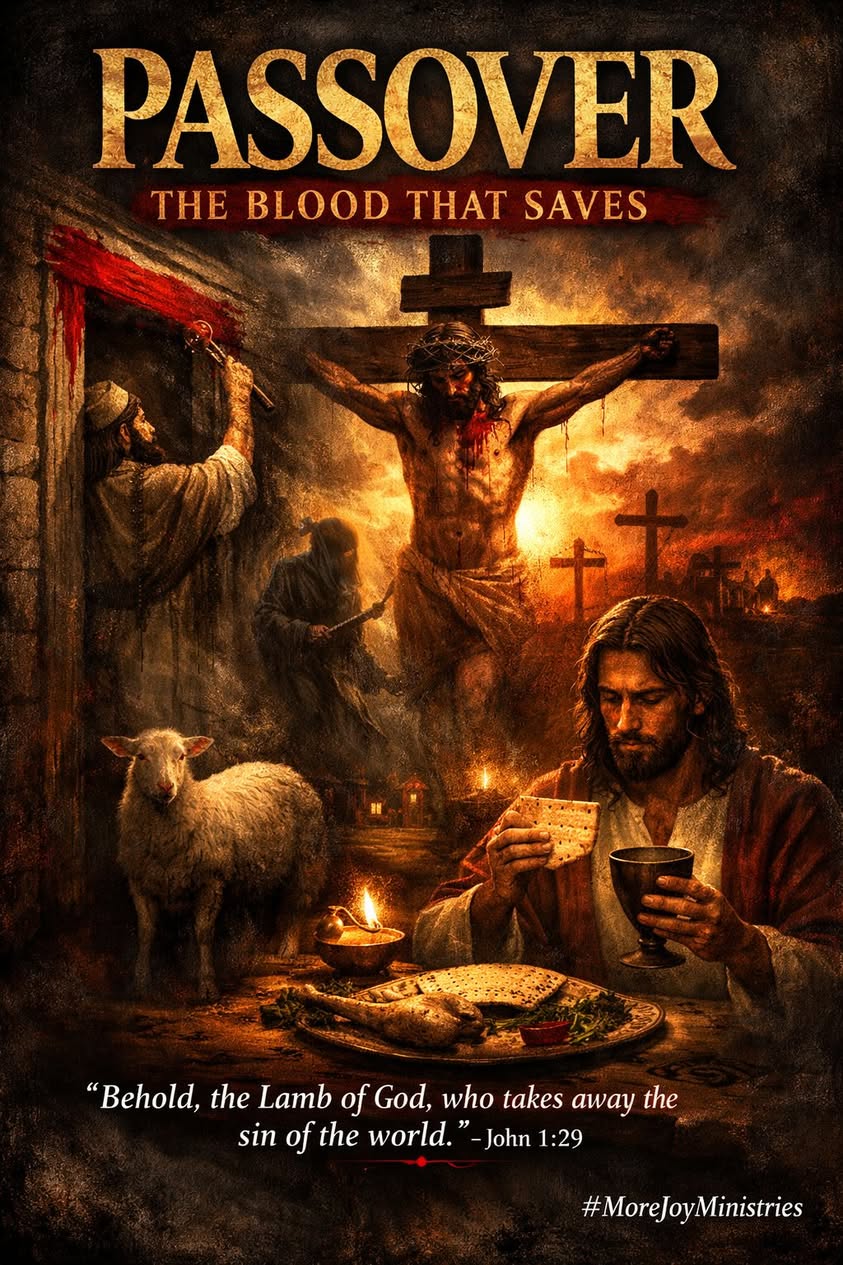
Tony Campbell added a new photo to the album: The Feasts .
The Feasts PASSOVER: (From Egypt to the Cross) Passover is one of the most important events in all of Scripture. In Hebrew it is called פֶּסַח (Pesach), meaning “to pass over” or “to spare.” It co
The Feasts PASSOVER:
(From Egypt to the Cross)
Passover is one of the most important events in all of Scripture.
In Hebrew it is called פֶּסַח (Pesach), meaning “to pass over” or “to spare.”
It commemorates the night when God delivered Israel from slavery in Egypt. But it is also far more than a historical event. Passover is a prophetic picture that ultimately points to Jesus Christ.
To understand the cross, you have to understand Passover.
The First Passover The story is recorded in Exodus 12–14.
After generations of slavery in Egypt, God sent Moses to confront Pharaoh and demand the release of Israel. Pharaoh refused, and God sent a series of devastating plagues upon the land.
The final plague would be the most severe.
God announced that the firstborn in every Egyptian household would die in one single night. But He also provided a way of escape.
Each Israelite family was commanded to sacrifice a spotless lamb.
They were instructed to take the lamb’s blood and apply it to the lintel and the two doorposts of their house using hyssop.
Exodus 12:13 says:
“When I see the blood, I will pass over you, and the plague shall not be upon you to destroy you.”
That night the Lord passed through Egypt. Every house without the blood experienced death. But every house marked by the blood was spared.
The blood of the lamb meant deliverance.
This was the birth of the nation of Israel.
The Feast of Unleavened Bread:
Passover immediately begins a seven-day festival called the Feast of Unleavened Bread.
Leviticus 23:5–6 says:
“In the fourteenth day of the first month at even is the LORD’S passover. And on the fifteenth day of the same month is the feast of unleavened bread unto the LORD: seven days ye must eat unleavened bread.”
Leaven in Scripture often symbolizes sin or corruption.
Before Passover, Jewish families remove all leaven from their homes. The bread eaten during the feast is matzah, bread made without yeast.
It is sometimes called “the bread of affliction.”
This reminded Israel of their hurried departure from Egypt when they had no time to let bread rise.
But again, this also foreshadows something greater.
Jesus Himself was sinless. No corruption. No leaven.
The Passover Meal:
The Passover meal is called the Seder.
The word סֵדֶר (seder) simply means “order.” The meal follows a structured sequence recounting the story of deliverance.
Several symbolic foods are eaten:
Matzah - unleavened bread Maror - bitter herbs representing the bitterness of slavery Charoset - a mixture symbolizing mortar used by slaves Four cups of wine - representing the four promises of redemption in Exodus 6:6–7
For thousands of years Jewish families have gathered to remember how God redeemed His people.
Passover and Jesus:
The New Testament reveals that Passover was pointing forward to something far greater.
Jesus celebrated Passover with His disciples the night before His crucifixion.
Luke 22:15 records His words:
“With desire I have desired to eat this passover with you before I suffer.”
During that meal, Jesus took the bread and the cup and gave them entirely new meaning.
The bread represented His body.
The cup represented His blood.
Luke 22:20:
“This cup is the new covenant in my blood, which is shed for you.”
The old covenant Passover remembered deliverance from Egypt.
The new covenant would bring deliverance from sin.
Jesus the Passover Lamb:
The Apostle Paul makes the connection unmistakably clear.
1 Corinthians 5:7 says:
“Christ our Passover is sacrificed for us.”
Just as the lamb in Egypt had to be without blemish, Jesus lived a completely sinless life.
Just as the lamb was sacrificed to spare the firstborn, Jesus died to spare humanity from judgment.
Just as the blood on the doorposts protected the household, the blood of Christ covers those who trust in Him.
The Gospel of John emphasizes this even further.
Jesus was crucified at the exact time the Passover lambs were being slaughtered in Jerusalem.
John the Baptist had already declared the truth years earlier.
John 1:29:
“Behold the Lamb of God, which taketh away the sin of the world.”
Passover was never only about Egypt.
It was about the cross.
A Picture Written 1,500 Years in Advance The details are stunning when you step back and look at them.
A spotless lamb. Sacrificed for deliverance. Blood applied for protection. No bones broken. A meal shared in remembrance.
All of it written more than 1,400 years before Jesus was crucified.
God was telling the story of redemption long before it happened.
Passover was the preview.
The cross was the fulfillment.
The Meaning of Passover Today:
For Israel, Passover celebrates freedom from slavery in Egypt.
For Christians, it reveals something even greater.
Humanity is enslaved not to Pharaoh, but to sin.
And just as Israel needed the blood of a lamb to escape judgment, we need the blood of Christ.
Salvation does not come through effort.
It comes through the Lamb.
The ni