
Tony Campbell added a new photo to the album: Spiritual Gifts.
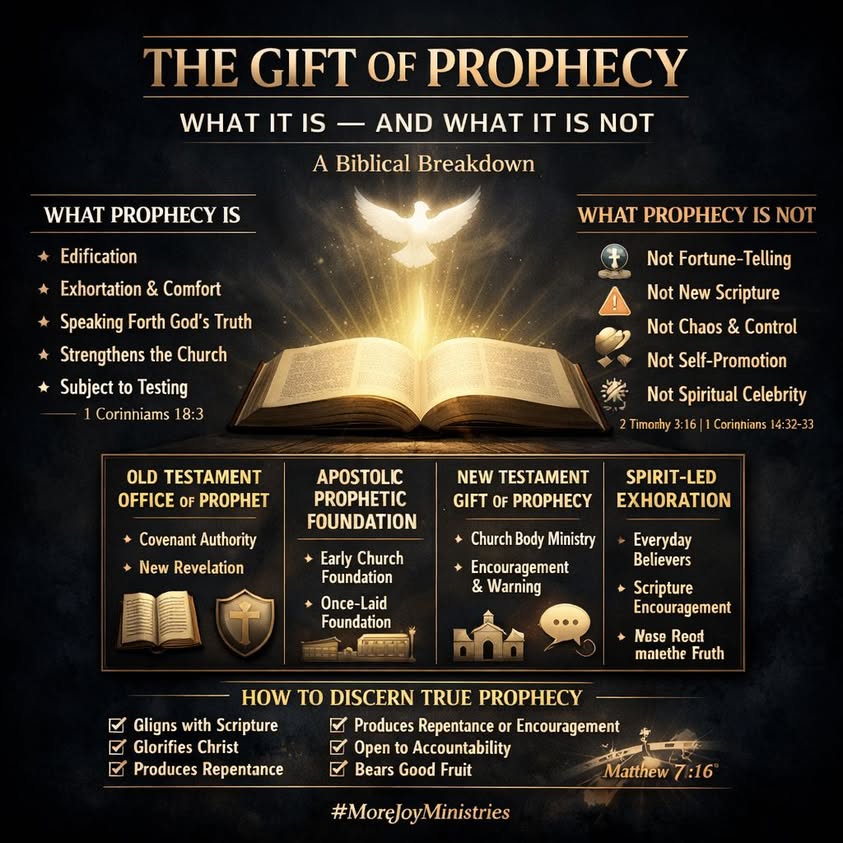
Spiritual GiftsTHE GIFT OF PROPHECY: (WHAT IT IS, AND WHAT IT IS NOT) (A BIBLICAL BREAKDOWN) Few spiritual gifts create more confusion, controversy, or misuse than the gift of prophecy. Some exaggera
Spiritual GiftsTHE GIFT OF PROPHECY: (WHAT IT IS, AND WHAT IT IS NOT) (A BIBLICAL BREAKDOWN)
Few spiritual gifts create more confusion, controversy, or misuse than the gift of prophecy. Some exaggerate it into fortune-telling. Others reject it entirely out of fear or abuse they have witnessed. Scripture does neither. The Bible gives a balanced, clear, and deeply structured understanding of prophecy that protects believers from deception while preserving one of God’s intended ways of strengthening His people.
To understand prophecy correctly, we must define both what it IS and what it IS NOT, and we must recognize that Scripture describes multiple prophetic roles that are often mistakenly blended together.
WHAT THE GIFT OF PROPHECY IS:
The clearest biblical definition appears in 1 Corinthians 14:3:
“But he that prophesieth speaketh unto men to edification, and exhortation, and comfort.”
The Greek word for prophecy is “prophēteia.” It literally means speaking forth or declaring something under divine influence. The word combines “pro,” meaning before or forth, and “phemi,” meaning to speak. This shows something important. Prophecy is not primarily predicting the future. It is speaking God’s truth into a situation under the prompting of the Holy Spirit.
Biblically, prophecy strengthens believers. It builds faith. It warns against sin. It encourages endurance. It brings conviction that leads to repentance. It confirms truth already revealed in God’s Word.
The New Testament shows prophecy frequently functioning as Spirit-led exhortation and strengthening of the church. Acts 15:32 tells us that Judas and Silas, who were prophets, exhorted believers and confirmed them in their faith. Notice that prophecy there was not predicting events. It was strengthening believers through truth.
Sometimes prophecy reveals things God wants exposed. First Corinthians 14:24-25 describes prophecy revealing secrets of the heart that lead someone to fall down, worship God, and acknowledge that God is truly present. This type of prophecy brings conviction, not entertainment.
Prophecy can occasionally include future revelation. The New Testament records Agabus predicting a famine in Acts 11:28 and warning Paul about imprisonment in Acts 21. However, these moments were rare and purposeful. They were never presented as daily or casual behavior.
One of the most important biblical truths about prophecy is that it must always be tested. First Thessalonians 5:20-21 instructs believers not to despise prophecy but to test everything and hold on to what is good. First Corinthians 14:29 commands that prophetic messages be evaluated by others. True prophecy invites accountability. False prophecy avoids it.
WHAT PROPHECY IS NOT
Prophecy is not fortune-telling. Scripture never presents prophecy as spiritual horoscope culture. When prophecy becomes constant personal predictions about the future, it begins resembling the divination practices God warned Israel against in Deuteronomy 18. Biblical prophecy points people toward repentance, obedience, and Christ — not curiosity about tomorrow.
Prophecy is not equal to Scripture. The Bible is complete and fully authoritative. Second Timothy 3:16 declares that Scripture is God-breathed and authoritative for doctrine, correction, and instruction. No modern prophetic message can add doctrine, override Scripture, or compete with the authority of God’s written Word. If any prophecy contradicts Scripture, it is automatically false.
Prophecy is not emotional chaos or loss of control. First Corinthians 14:32-33 teaches that the spirits of prophets are subject to the prophets and that God is not the author of confusion. True spiritual gifting includes self-control. Disorder is not evidence of spiritual power.
Prophecy is not self-promotion or spiritual celebrity. Throughout Scripture, prophets were usually reluctant, humble, and deeply burdened by the responsibility they carried. Moses argued with God about being chosen. Jeremiah attempted to stop prophesying because of persecution. Amos insisted he was not a professional prophet. Modern prophecy culture often chases platforms and attention, which should cause believers to exercise caution.
Prophecy is not always about predicting national or global events. Most prophecy in the New Testament church involved strengthening believers personally and spiritually.
THE FOUR DIFFERENT PROPHETIC FUNCTIONS IN SCRIPTURE:
Many modern misunderstandings occur because believers combine four distinct biblical categories into one. Scripture actually presents multiple prophetic functions.
THE OLD TESTAMENT OFFICE OF PROPHET:
This is the role most people imagine when they hear the word prophet. These were individuals directly commissioned by God to speak revelation with covenant and national authority. Examples include Moses, Isaiah, Jeremiah, Ezekiel, and Daniel.
Deuteronomy 18:18 describes God raising prophets and placing His words directly in their mouths. The