
Tony Campbell added a new photo to the album: Principalities and Powers.
Principalities and PowersBAAL: (A BIBLICAL STUDY) The name Baal shows up all over the Old Testament, and understanding who Baal was explains a lot about Israel’s constant struggle with idolatry. The
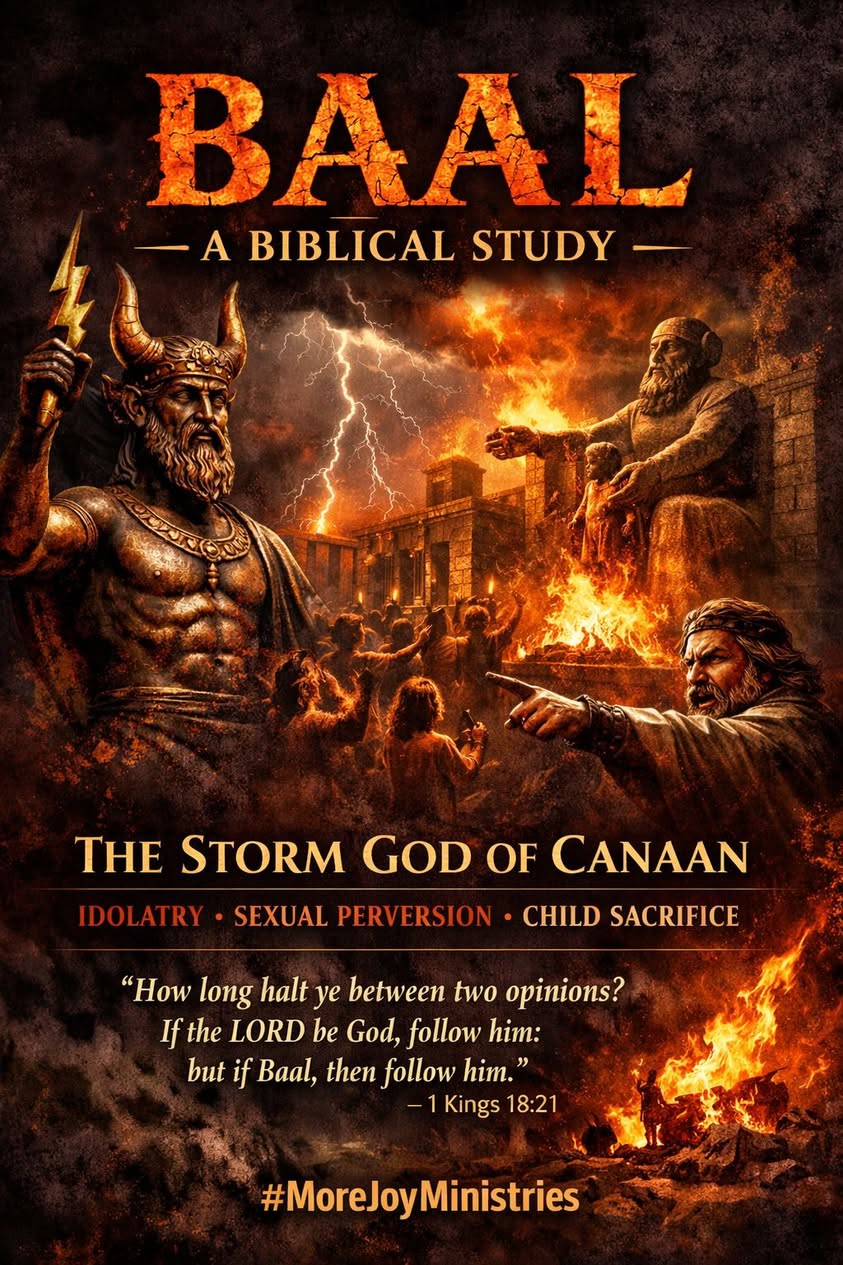
Principalities and PowersBAAL: (A BIBLICAL STUDY)
The name Baal shows up all over the Old Testament, and understanding who Baal was explains a lot about Israel’s constant struggle with idolatry.
The word Baal comes from the Hebrew בַּעַל (baʿal). It literally means lord, master, or owner. In everyday Hebrew the word could even refer to a husband or someone who possessed authority over something.
But over time the title became the name of a specific god worshiped throughout Canaan and the surrounding regions.
In Canaanite religion Baal was believed to be the storm god, the one who controlled rain, lightning, and agricultural fertility. In an ancient farming culture rain meant survival. Crops depended on it. Food depended on it. So people believed Baal controlled prosperity itself.
That belief system spread all through the land of Canaan, and when Israel entered the land it became one of the greatest spiritual threats they faced.
Judges describes the problem bluntly.
“And the children of Israel did evil in the sight of the LORD, and served Baalim. And they forsook the LORD God of their fathers… and followed other gods… even Baal and Ashtaroth.” Judges 2:11–13
Notice the word Baalim. That is simply the plural form of Baal. There wasn’t just one centralized Baal cult. Different cities and regions had their own version of the same deity. Scripture mentions several of them such as Baal-Peor, Baal-Berith, and Baal-Zebub.
The system surrounding Baal worship was extremely corrupt. It revolved around fertility rituals that mixed religion with sexual immorality. Temple prostitution was part of the practice because the people believed human sexual acts would somehow stimulate the gods to make the land fertile.
Even worse, in some places Baal worship became connected with child sacrifice.
Jeremiah condemns this practice directly.
“They have built also the high places of Baal, to burn their sons with fire for burnt offerings unto Baal.” Jeremiah 19:5
So when the prophets attacked Baal worship, they were not arguing about minor religious differences. They were confronting a system that involved sexual corruption, spiritual deception, and in some cases the killing of children.
One of the most famous confrontations happens in 1 Kings 18 during the reign of King Ahab. Under the influence of Jezebel, Israel had fallen deep into Baal worship. Hundreds of prophets of Baal were supported by the royal court.
The prophet Elijah challenged them on Mount Carmel.
“How long halt ye between two opinions? If the LORD be God, follow him: but if Baal, then follow him.” 1 Kings 18:21
The prophets of Baal cried out all day. They cut themselves. They danced around the altar. But nothing happened.
Because Baal was never there.
Then Elijah prayed once. God answered immediately with fire from heaven that consumed the sacrifice, the altar, the stones, and even the water in the trench.
The people fell on their faces and declared, “The LORD, he is the God.”
The story exposes something important. Baal worship was never really about a real god. It was about people trusting in something created instead of the Creator.
That pattern has never gone away.
Baal simply changes names.
Power. Money. Sex. Pleasure. Success.
Anything that takes the place of God as the source of blessing becomes a modern Baal.
Jesus later summed up the same principle very simply.
“No man can serve two masters.” Matthew 6:24
Israel struggled with that choice for centuries.
And honestly, every generation still does.
#MoreJoyMinistriesBAAL: (A BIBLICAL STUDY) The name Baal shows up all over the Old Testament, and understanding who Baal was explains a lot about Israel’s constant struggle with idolatry. The word Baal comes from the Hebrew בַּעַל (baʿal). It literally means lord, master, or owner. In everyday Hebrew the word could even refer to a husband or someone who possessed authority over something. But over time the title became the name of a specific god worshiped throughout Canaan and the surrounding regions. In Canaanite religion Baal was believed to be the storm god, the one who controlled rain, lightning, and agricultural fertility. In an ancient farming culture rain meant survival. Crops depended on it. Food depended on it. So people believed Baal controlled prosperity itself. That belief system spread all through the land of Canaan, and when Israel entered the land it became one of the greatest spiritual threats they faced. Judges describes the problem bluntly. “And the children of Israel did evil in the sight of the LORD, and served Baalim. And they forsook the LORD God of their fathers… and followed other gods… even Baal and Ashtaroth.” Judges 2:11–13 Notice the word Baalim. That is simply the plural form of Baal. There wasn’t just one centralized Baal cult. Different cities and regions had their own version of the same deity. Scripture mentions several of them such as Baal-Peor, Baal-Berith, and Baal-Zebub. The system surrounding