
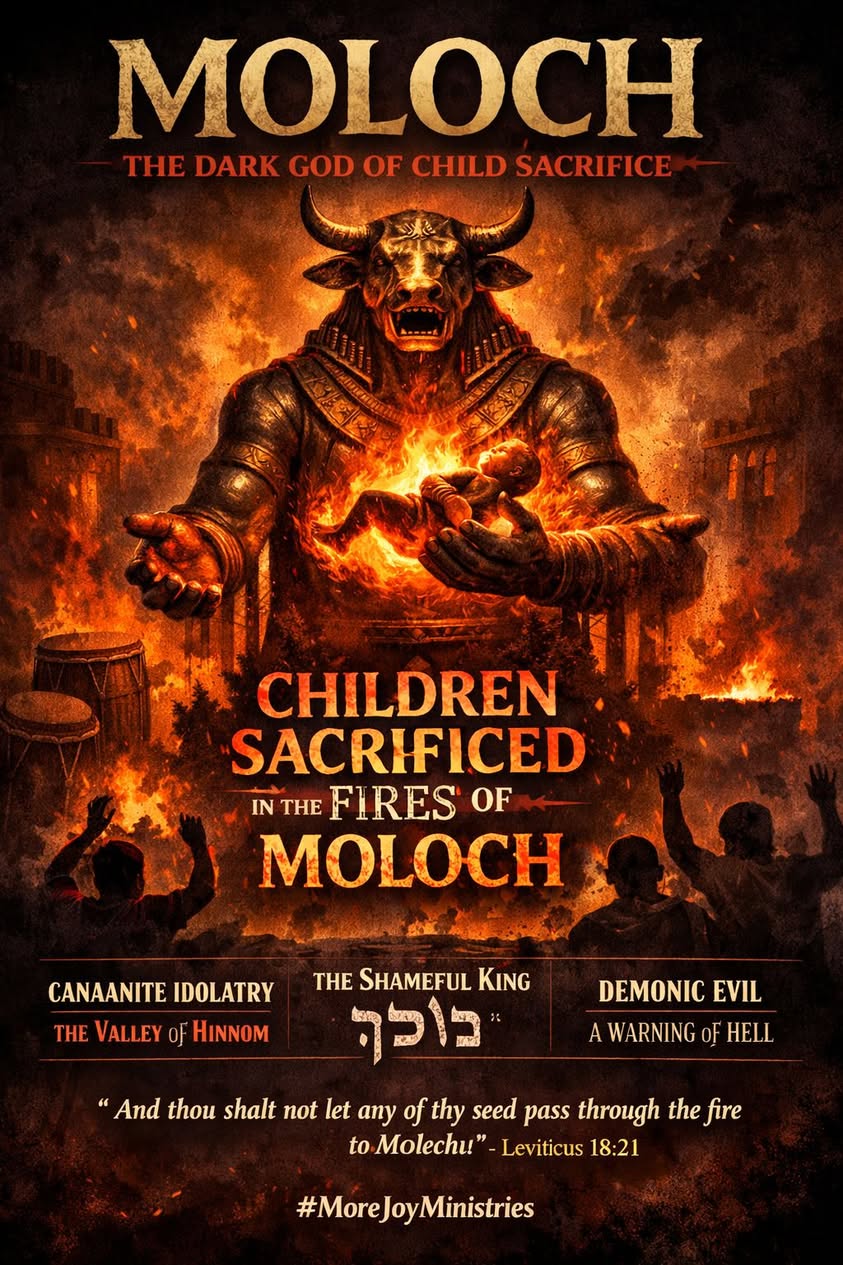
Tony Campbell added a new photo to the album: Principalities and Powers.
Principalities and PowersMOLOCH: (THE DARK GOD OF CHILD SACRIFICE) One of the most disturbing names in the entire Bible is Moloch. His worship represents one of the darkest forms of pagan religion
Principalities and PowersMOLOCH:
(THE DARK GOD OF CHILD SACRIFICE)
One of the most disturbing names in the entire Bible is Moloch. His worship represents one of the darkest forms of pagan religion in the ancient world: the sacrifice of children by fire.
Understanding Moloch explains why God repeatedly warned Israel not to imitate the nations around them and why the Canaanite cultures eventually came under judgment.
The name Moloch comes from the Hebrew word Mōleḵ (מֹלֶךְ). It is closely related to the Hebrew word melek, meaning “king.” Many scholars believe the biblical writers intentionally altered the vowels to make the name sound like the Hebrew word bosheth, meaning “shame.” In other words, the writers of Scripture were essentially calling him “the shameful king.”
Moloch was worshiped primarily by the Ammonites and other Canaanite peoples. In 1 Kings 11:5 we read that the Ammonites worshiped a god named Milcom, which many scholars consider a related form of the same deity.
But what made Moloch worship infamous was not simply idolatry. It was child sacrifice.
God explicitly forbade this practice in the Law.
Leviticus 18:21 says:
“And thou shalt not let any of thy seed pass through the fire to Molech.”
The warning is repeated even more strongly in Leviticus 20:2–5, where God commands that anyone who sacrifices their children to Moloch should face the death penalty. The severity of the command shows how seriously God viewed this sin.
Historical descriptions and archaeological studies suggest that Moloch may have been represented by a large bronze statue, often depicted with the head of a bull and outstretched arms. A fire would be lit inside or beneath the statue until the metal became extremely hot. The child would then be placed into the burning arms or into the furnace-like structure of the idol.
Ancient sources describe drums being beaten loudly during the ritual to drown out the cries.
These sacrifices were often performed in a place called Topheth, located in the Valley of Hinnom just outside Jerusalem.
The prophet Jeremiah condemned these practices with shocking clarity.
Jeremiah 7:31 says:
“They have built the high places of Tophet… to burn their sons and their daughters in the fire; which I commanded them not, neither came it into my heart.”
That last phrase is powerful. God says this practice never even entered His heart. It was completely contrary to His character.
Even Israel fell into this sin.
In 1 Kings 11:7 we read that King Solomon, influenced by his foreign wives, built a high place for Molech. Later, one of Judah’s most wicked kings, Manasseh, actually sacrificed his own son in the fire (2 Kings 21:6).
The Valley of Hinnom eventually became so associated with these atrocities that it turned into a symbol of divine judgment. In the New Testament, Jesus uses the Greek form of the name for this valley ' Gehenna ' as an image of hell.
The Bible explains that these sacrifices were not merely offered to idols. Psalm 106:37–38 says the people “sacrificed their sons and their daughters unto devils.”
Behind the idols were demonic powers.
Moloch worship shows how far human religion can fall when it separates from the true God. Instead of protecting children, societies began sacrificing them in the hope of gaining power, prosperity, or blessing.
The contrast with the gospel could not be more striking.
False gods demanded the sacrifice of children.
But the true God did the opposite.
God gave His own Son so that humanity could live.
#MoreJoyMinistriesMOLOCH: (THE DARK GOD OF CHILD SACRIFICE) One of the most disturbing names in the entire Bible is Moloch. His worship represents one of the darkest forms of pagan religion in the ancient world: the sacrifice of children by fire. Understanding Moloch explains why God repeatedly warned Israel not to imitate the nations around them and why the Canaanite cultures eventually came under judgment. The name Moloch comes from the Hebrew word Mōleḵ (מֹלֶךְ). It is closely related to the Hebrew word melek, meaning “king.” Many scholars believe the biblical writers intentionally altered the vowels to make the name sound like the Hebrew word bosheth, meaning “shame.” In other words, the writers of Scripture were essentially calling him “the shameful king.” Moloch was worshiped primarily by the Ammonites and other Canaanite peoples. In 1 Kings 11:5 we read that the Ammonites worshiped a god named Milcom, which many scholars consider a related form of the same deity. But what made Moloch worship infamous was not simply idolatry. It was child sacrifice. God explicitly forbade this practice in the Law. Leviticus 18:21 says: “And thou shalt not let any of thy seed pass through the fire to Molech.” The warning is repeated even more strongly in Leviticus 20:2–5, where God commands that anyone who sacrifices their children to Moloch should face the death penalty. The severity of the command shows how seriously God viewed this sin. His