
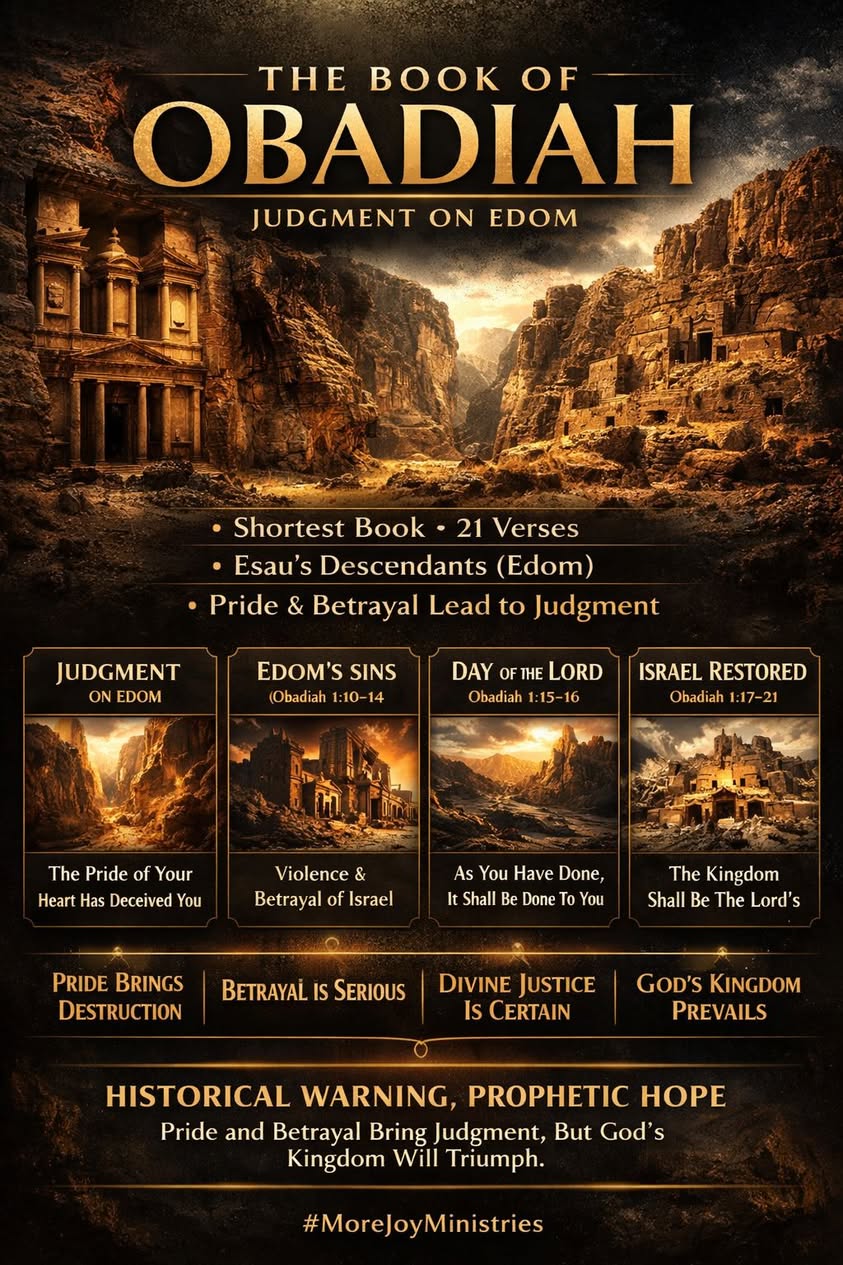
Tony Campbell added a new photo to the album: People Of The Bible.
People Of The BibleThe Book Of Obadiah: The book of Obadiah is the shortest book in the Old Testament, containing only twenty one verses, yet it delivers one of the strongest prophetic warnings in S
People Of The BibleThe Book Of Obadiah:
The book of Obadiah is the shortest book in the Old Testament, containing only twenty one verses, yet it delivers one of the strongest prophetic warnings in Scripture. The entire message centers on the judgment of Edom, the nation descended from Esau, the twin brother of Jacob. To understand Obadiah, you must understand a family conflict that began in Genesis and grew into a national hostility lasting over a thousand years.
The name Obadiah means Servant of Yahweh. The book was most likely written after the destruction of Jerusalem around 586 BC. The primary theme of the book is that God judges pride, betrayal, and violence against His covenant people. The central message reveals that nations cannot escape divine justice.
The root of the conflict between Israel and Edom begins with Jacob and Esau. Jacob became Israel. Esau became Edom. The conflict between them began even before birth. Genesis 25:23 records God telling their mother, “Two nations are in your womb.” Esau later despised his birthright while Jacob received the covenant blessing. That spiritual division eventually became geopolitical hostility between two nations.
The name Edom comes from the Hebrew word Adom, which means red. This connects to Esau’s red hair, the red stew he traded his birthright for, and the red sandstone mountains where Edom lived. Even linguistically, Edom came to symbolize fleshly appetite placed above spiritual inheritance.
The book of Obadiah divides naturally into four major sections.
The first section is Obadiah 1:1 through 1:9, where judgment is pronounced against Edom. God announces that Edom will be humbled. The central theme in this section is pride. Obadiah 1:3 says, “The pride of your heart has deceived you.” Edom trusted in its mountain fortresses, military alliances, trade wealth, and natural defenses. Their capital city, Petra, was built within cliffs that were nearly impossible to invade. Edom believed their geography made them invincible. God declares that no earthly security can protect against divine justice.
The Hebrew word often associated with this type of pride is Zadon, which means arrogance or presumption. This is not healthy confidence. This describes self exaltation against God.
The second section is Obadiah 1:10 through 1:14, which explains Edom’s sin. This is the heart of the book because God explains why judgment is coming. When Babylon attacked Jerusalem, Edom celebrated Israel’s fall. They stood by without helping. They looted Jerusalem. They captured fleeing Jews. They delivered survivors into enemy hands. This was not simply national conflict. It was betrayal of family covenant.
Edom was not judged simply for violence. They were judged because they knew better. They were relatives of Israel. Scripture teaches a principle of covenant accountability. Luke 12:48 states that to whom much is given, much will be required. Greater revelation produces greater responsibility.
The third section is Obadiah 1:15 through 1:16 and introduces the Day of the Lord. The prophecy now expands beyond Edom and speaks to a global pattern of divine justice. Obadiah declares, “As you have done, it shall be done to you.” The Hebrew word for day is Yom. Yom can mean a literal day, but prophetically it often describes a period of divine intervention when God steps directly into human history.
The punishment pattern applied to Edom becomes universal. This points forward to Tribulation judgments, the final global reckoning, and the transition into the Messianic Kingdom.
The fourth section is Obadiah 1:17 through 1:21 and reveals Israel’s future restoration. The book ends with hope. Scripture declares, “On Mount Zion shall be deliverance.” God promises Israel will be restored, territory will be reclaimed, the Kingdom will be established, and the Lord will reign universally.
The final verse of Obadiah states, “The kingdom shall be the Lord’s.” This directly connects to Messianic Kingdom prophecy and finds a parallel in Revelation 11:15 which declares that the kingdoms of this world become the kingdoms of our Lord.
Several prophetic themes appear throughout Obadiah. Pride brings destruction. Proverbs 16:18 teaches that pride goes before destruction. God defends His covenant people. Even when Israel is disciplined, God still protects His covenant promises. Betrayal is spiritually serious. Edom represents betrayal from those closest to truth. Psalm 55 describes the pain of betrayal by a familiar companion. Obadiah also emphasizes that divine justice is inevitable. The book presents moral symmetry in which what is sown is eventually reaped.
Obadiah also connects prophetically to end time events. Many scholars see Edom as a historical foreshadowing of future anti God coalitions. The Day of the Lord language in Obadiah parallels Joel chapter two, Zechariah chapter fourteen, and Revelation chapters six through nineteen. The prophetic pattern remains consistent throughout Scri