
Tony Campbell added a new photo to the album: People Of The Bible.
People Of The BibleKING AHASUERUS (XERXES): The name Xerxes does not appear in the Hebrew text of Scripture. In Hebrew, the king in the book of Esther is called Ahasuerus. That is how the KJV and ES
People Of The BibleKING AHASUERUS (XERXES):
The name Xerxes does not appear in the Hebrew text of Scripture.
In Hebrew, the king in the book of Esther is called Ahasuerus. That is how the KJV and ESV preserve it. Modern translations like the NIV and NASB render the name as Xerxes.
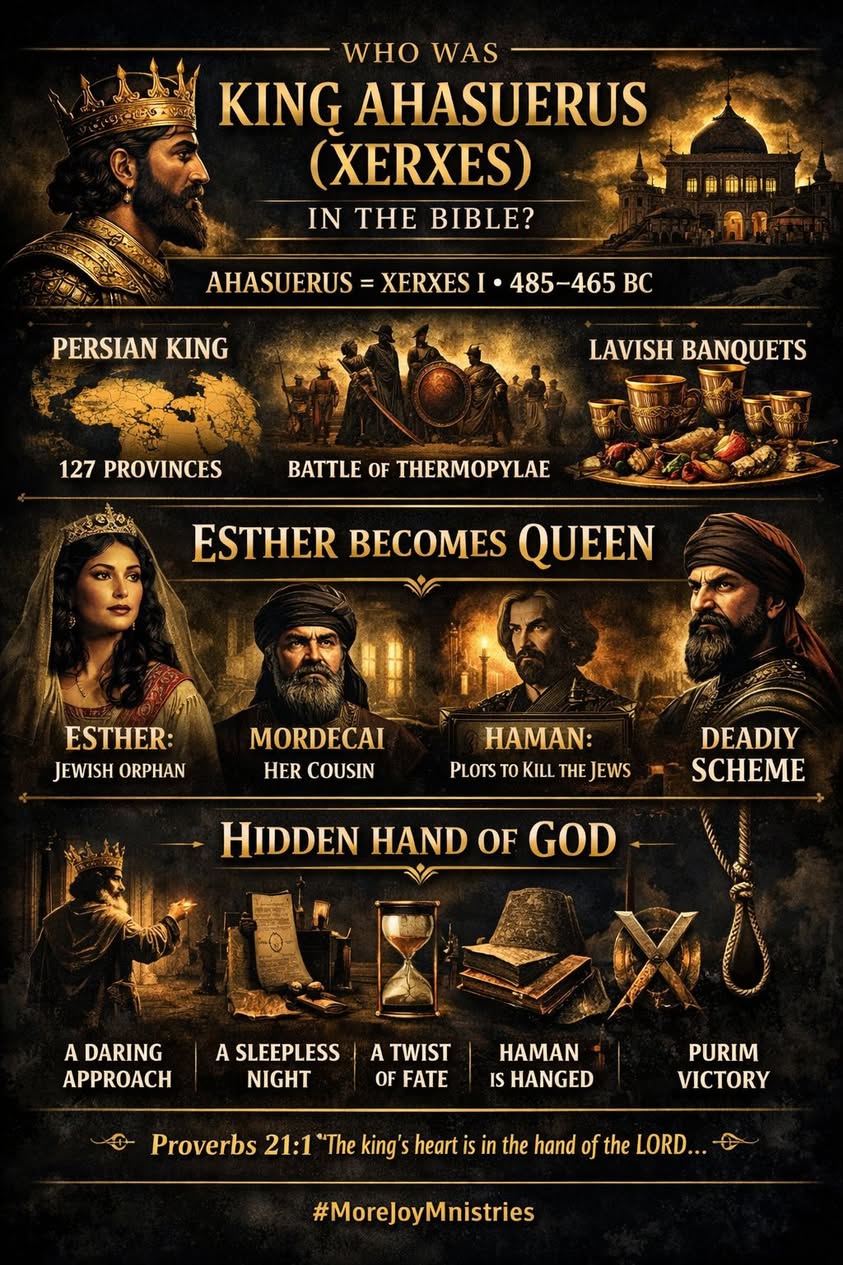
Most scholars identify Ahasuerus with Xerxes I, son of Darius I and ruler of the Persian Empire from 485–465 BC.
The Hebrew name “Ahasuerus” can reasonably be derived from the Old Persian name Khshayarsha - which the Greeks rendered as Xerxes.
The Greek Septuagint complicates things by using the name Artaxerxes, but historically, Xerxes I best fits the timeline and details of Esther.
Now look at the man himself.
Xerxes ruled the Achaemenid Empire at its height. His domain stretched from India to Ethiopia. Esther 1:1 says Ahasuerus ruled over 127 provinces. That matches Persian history.
He had a palace in Susa. Archaeology confirms this.
He was known for lavish feasts. Esther opens with a 180-day display of royal wealth followed by a 7-day banquet fueled by wine. Persian records describe similar extravagance.
He was impulsive. Temperamental. Easily influenced by advisors. History and Scripture agree on that too.
He famously invaded Greece in 480 BC. His army passed through Thermopylae, where the 300 Spartans made their stand. Though he initially advanced, his navy suffered a decisive defeat at Salamis. He returned home humiliated and turned his attention inward.
It is very likely the events of Esther take place after this failed campaign.
Now step into the book.
In Esther 1, Xerxes drunkenly commands Queen Vashti to appear before his nobles. She refuses. He deposes her in anger.
In Esther 2, a search begins for a new queen. Young women are gathered into the royal harem. Among them is Esther, a Jewish orphan raised by her cousin Mordecai.
She becomes queen, but keeps her Jewish identity secret.
Mordecai uncovers a plot to assassinate the king. He reports it. The king’s life is spared.
In Esther 3, Haman, one of Xerxes’ top officials, plots genocide against the Jews because Mordecai refuses to bow to him. Xerxes authorizes the decree without investigating the details. He does not even realize Esther herself is Jewish.
In Esther 4, Mordecai urges Esther to approach the king uninvited.. a move punishable by death.
“For such a time as this.”
She risks her life.
In Esther 5–7, the drama unfolds. A sleepless night. A forgotten reward. A public humiliation. A gallows built for Mordecai becomes the instrument of Haman’s own death.
In Esther 8–9, the king allows the Jews to defend themselves. They survive. The feast of Purim is established.
Now here is the deeper truth.
God’s name is never mentioned in Esther.
No miracles. No burning bushes. No parted seas.
But providence saturates every page.
The king’s insomnia. The reading of the chronicles. The exact moment Haman walks in. The timing of Esther’s banquets.
What looks like coincidence is sovereignty working quietly.
Xerxes thinks he is ruling the world.
But Proverbs 21:1 says, “The king’s heart is in the hand of the LORD… He turns it wherever He will.”
Xerxes was powerful. But he was not ultimate.
He was a pagan emperor used by an unseen God to preserve a covenant people through whom the Messiah would eventually come.
History remembers Xerxes for military ambition and imperial power.
Scripture remembers him as a tool in the hand of Providence.
And that is the real lesson.
No throne outranks God. No decree overrides Him. No empire operates outside His will.
Even when His name is not mentioned, His hand is still moving.
- @[61583539981347:2048:More Joy Ministries]
#MoreJoyMinistriesKING AHASUERUS (XERXES): The name Xerxes does not appear in the Hebrew text of Scripture. In Hebrew, the king in the book of Esther is called Ahasuerus. That is how the KJV and ESV preserve it. Modern translations like the NIV and NASB render the name as Xerxes. Most scholars identify Ahasuerus with Xerxes I, son of Darius I and ruler of the Persian Empire from 485–465 BC. The Hebrew name “Ahasuerus” can reasonably be derived from the Old Persian name Khshayarsha - which the Greeks rendered as Xerxes. The Greek Septuagint complicates things by using the name Artaxerxes, but historically, Xerxes I best fits the timeline and details of Esther. Now look at the man himself. Xerxes ruled the Achaemenid Empire at its height. His domain stretched from India to Ethiopia. Esther 1:1 says Ahasuerus ruled over 127 provinces. That matches Persian history. He had a palace in Susa. Archaeology confirms this. He was known for lavish feasts. Esther opens with a 180-day display of royal wealth followed by a 7-day banquet fueled by wine. Persian records describe similar extravagance. He was impulsive. Temperamental. Easily influenced by advisors. History and Scripture agree on that too. He famously invaded Greece in 480 BC. His army passed through Thermopylae, where the 300 Spart