
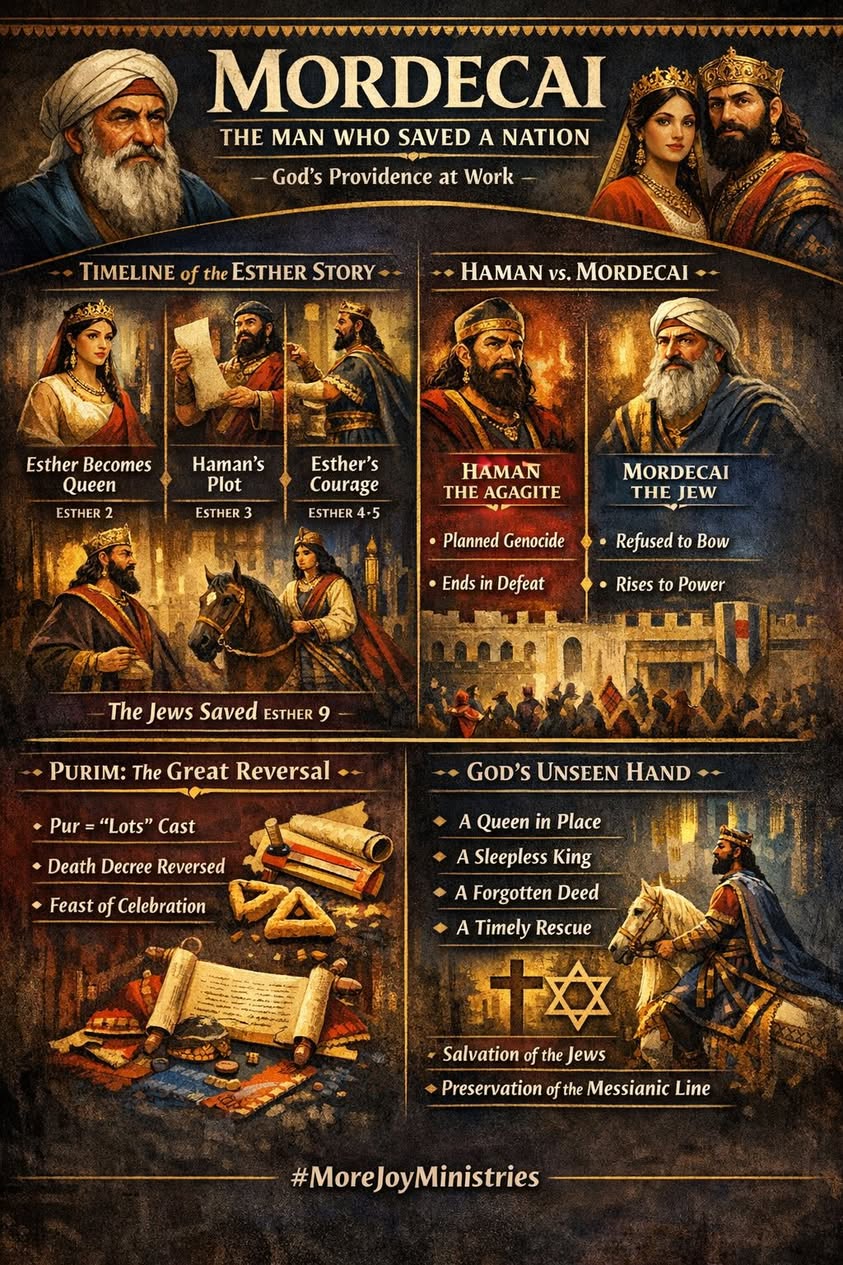
Tony Campbell added a new photo to the album: People Of The Bible.
People Of The BibleMORDECAI: (THE MAN GOD USED TO SAVE A NATION) The story of Mordecai is one of the most powerful demonstrations in Scripture of God’s providence working quietly behind the scenes.
People Of The BibleMORDECAI:
(THE MAN GOD USED TO SAVE A NATION)
The story of Mordecai is one of the most powerful demonstrations in Scripture of God’s providence working quietly behind the scenes.
The Book of Esther never directly mentions the name of God, yet the fingerprints of God are everywhere. And right at the center of that story stands a Jewish man named Mordecai.
His life shows how courage, faithfulness, and obedience can change the course of history.
Let’s examine who he was and why he matters.
THE MAN:
Mordecai was a Jew living in exile in the Persian Empire during the reign of King Ahasuerus (Xerxes I), around the 5th century BC.
Esther 2:5 says:
“Now in Shushan the palace there was a certain Jew, whose name was Mordecai, the son of Jair, the son of Shimei, the son of Kish, a Benjamite.”
That last detail matters.
Mordecai was from the tribe of Benjamin, the same tribe as King Saul. His family had been carried away during the Babylonian captivity under Nebuchadnezzar.
So Mordecai represents a generation of Jews living far from Jerusalem, yet still holding on to their identity as the people of God.
THE ADOPTIVE FATHER:
Mordecai raised his cousin Esther after her parents died.
Esther 2:7 says he “brought up Hadassah (that is, Esther)… for she had neither father nor mother.”
He did not simply watch over her. He raised her as his own daughter.
And when Esther was taken into the Persian palace and eventually became queen, Mordecai continued to guide and counsel her.
His quiet faithfulness set the stage for everything that followed.
THE MAN WHO REFUSED TO BOW:
The crisis begins when Haman is promoted to high office in the Persian government.
The king commanded that everyone bow before Haman.
But Mordecai refused.
Esther 3:2 says:
“All the king’s servants… bowed and reverenced Haman: for the king had so commanded… but Mordecai bowed not, nor did him reverence.”
Scripture never explicitly states the reason, but many scholars believe Mordecai refused because Haman was an Agagite.
That detail may connect Haman to the Amalekites - the ancient enemies of Israel (Exodus 17:14–16).
If that is the case, the conflict between Mordecai and Haman becomes part of a much older spiritual battle between Israel and Amalek.
Haman’s response was not merely personal anger.
He decided to destroy the entire Jewish people.
THE GENOCIDE PLOT:
Esther 3:6 says Haman sought to destroy “all the Jews that were throughout the whole kingdom of Ahasuerus.”
This was a planned genocide across the entire Persian Empire.
Haman cast “Pur” (lots) to determine the date of destruction. This is where the Jewish feast of Purim later gets its name.
The decree was written, sealed with the king’s ring, and sent across the empire.
The Jewish people were sentenced to death.
Humanly speaking, it looked like the end.
But God had already positioned the right people in the right places.
THE TURNING POINT:
When Mordecai learned of the decree, he sent word to Esther and urged her to go before the king.
This was extremely dangerous.
Approaching the king uninvited could result in immediate execution.
Esther hesitated.
Mordecai’s response is one of the most famous statements in the Bible.
Esther 4:14
“For if thou altogether holdest thy peace at this time, then shall there enlargement and deliverance arise to the Jews from another place… and who knoweth whether thou art come to the kingdom for such a time as this?”
That line reveals Mordecai’s faith.
Even under a death sentence, he believed God would deliver His people.
He simply recognized that Esther might be the instrument God had placed in position for that moment.
FOR SUCH A TIME AS THIS:
Esther chose courage.
She fasted. She prayed. And she went before the king.
Through a series of events that clearly show God’s providence, Haman’s plan unraveled.
One night the king could not sleep.
The royal chronicles were read.
And the king discovered something he had forgotten.
Mordecai had once exposed a plot to assassinate the king.
He had never been rewarded.
That single forgotten moment changed everything.
The next morning Haman himself was forced to lead Mordecai through the city declaring his honor.
Esther then revealed Haman’s plot to destroy the Jews.
Haman was executed on the very gallows he had built for Mordecai.
THE GREAT REVERSAL:
The story of Esther is built around one theme.
Reversal.
The decree meant to destroy the Jews became the moment of their deliverance.
Haman fell.
Mordecai was elevated to second in command under the king.
Esther 10:3 says:
“For Mordecai the Jew was next unto king Ahasuerus… seeking the wealth of his people, and speaking peace to all his seed.”
The man who once sat quietly at the king’s gate became one of the most powerful men in the empire.
THE LESSONS FROM MORDECAI:
- Faithfulness in small places matters. Mordecai was not a king or prophet. He was simply a man sitting at the city gate doing his duty.
B