
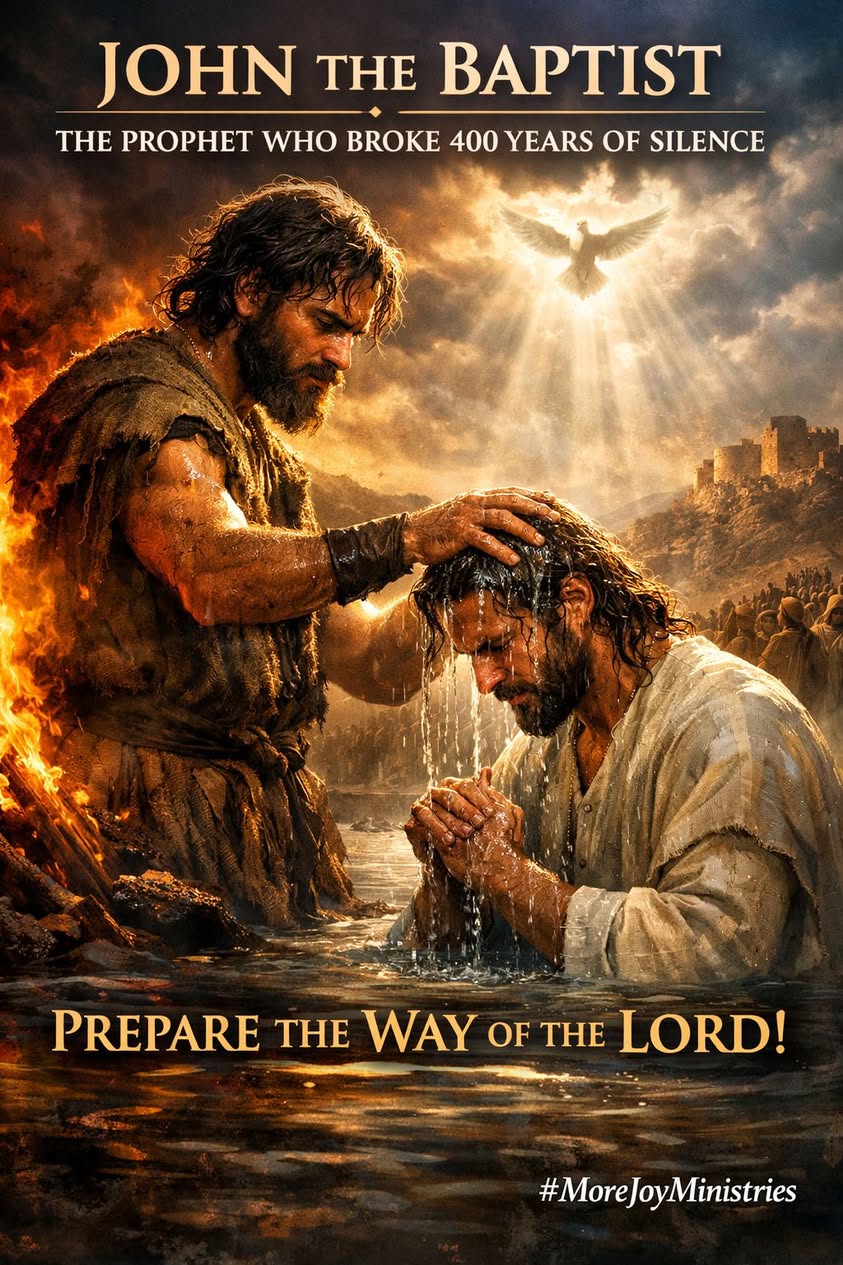
Tony Campbell added a new photo to the album: People Of The Bible.
People Of The BibleJOHN THE BAPTIST: THE PROPHET WHO BROKE 400 YEARS OF SILENCE Apart from Jesus Christ Himself, John the Baptist is one of the most theologically important figures in the entire Gosp
People Of The BibleJOHN THE BAPTIST: THE PROPHET WHO BROKE 400 YEARS OF SILENCE
Apart from Jesus Christ Himself, John the Baptist is one of the most theologically important figures in the entire Gospel record.
His birth was no ordinary event.
Like Jesus, John's birth was announced by an angel and marked by divine intervention (Luke 1:5–25). When he was born, his father Zechariah prophesied under the power of the Holy Spirit about the role this child would play in God's plan (Luke 1:67–79).
His birth even echoes the miraculous birth of Isaac to Abraham and Sarah centuries earlier (Genesis 17:15–22; 21:1–7).
From the very beginning, John was set apart.
Yet after this miraculous beginning, Scripture says he grew up in the wilderness (Luke 1:80). For years he lived in obscurity in the desert.
Then suddenly he appeared.
And when he did, four hundred years of prophetic silence ended.
Since the time of Malachi, no prophet had spoken with divine authority in Israel. John shattered that silence.
He was the fulfillment of Isaiah's prophecy:
“A voice of one crying in the wilderness, Prepare the way of the Lord.” Isaiah 40:3
John stood at a turning point in history.
He represents the bridge between the Old Testament and the New. One foot in the age of the prophets… and the other standing at the arrival of the Messiah.
His message was simple, direct, and urgent:
“Repent, for the kingdom of heaven is at hand.” Matthew 3:2
The word “repent” comes from the Greek word μετάνοια (metanoia) meaning a complete change of mind that leads to a change of life.
Those who responded to this message were baptized in the Jordan River as a public sign of repentance. That practice is why he became known as John the Baptist.
But John was not a soft preacher.
He preached like a prophet standing at the edge of judgment.
“The axe is laid to the root of the trees.” Matthew 3:10
He warned that God would separate the wheat from the chaff and purge His threshing floor (Matthew 3:12).
Repentance, John said, was not just words.
It had to produce fruit.
Share with those who have nothing. Stop extortion. Stop corruption. Live honestly before God. (Luke 3:11–14)
His life matched his message.
John lived in the wilderness wearing garments of camel hair and eating locusts and wild honey (Matthew 3:4). He was not trying to impress anyone. He wasn't building a brand or chasing popularity.
People came to him because the power of God was on his message.
John also refused to play religious games.
When the Pharisees and Sadducees came to observe him, he rebuked them publicly:
“You brood of vipers.” Matthew 3:7
He also confronted political corruption head-on.
When King Herod took his brother's wife, John publicly declared it sinful. That boldness cost him his freedom and eventually his life.
John died a martyr rather than compromise truth (Matthew 14:3–12).
Luke tells us John came “in the spirit and power of Elijah” (Luke 1:17).
The prophet Malachi had foretold that Elijah would come before the great Day of the Lord (Malachi 4:5). Because of that prophecy, many wondered if John literally was Elijah returned.
John denied being Elijah himself (John 1:21).
Yet Jesus later clarified the mystery.
John fulfilled the Elijah prophecy in role and spirit, not as reincarnation (Matthew 17:11–13).
Jesus made an extraordinary statement about John:
“Among those born of women there has not risen one greater than John the Baptist.” Matthew 11:11
Why?
Because John had the privilege of pointing directly to the Messiah and declaring:
“Behold the Lamb of God who takes away the sin of the world.” John 1:29
Yet John fully understood his role.
He repeatedly insisted he was not the Christ. He described himself simply as a witness to the Light (John 1:6–9).
His famous words summarize his humility perfectly:
“He must increase, but I must decrease.” John 3:30
Even great prophets have moments of struggle.
While imprisoned by Herod, John began to wonder if Jesus truly was the Messiah he had expected (Matthew 11:2–3). Jesus responded not with anger, but with evidence of fulfilled prophecy and a gentle warning:
“Blessed is the one who is not offended by me.” Matthew 11:6
Despite his imprisonment and death, John's influence did not disappear.
His disciples continued spreading his teachings throughout the Mediterranean world. In Acts we even see followers of John decades later who had only received his baptism (Acts 18:24–25; Acts 19:1–7).
John the Baptist was more than a preacher.
He was the last prophet of the old covenant, the forerunner of the Messiah, and the man chosen by God to announce the arrival of Christ to the world.
After four centuries of silence, God sent a voice.
And that voice cried out in the wilderness:
Prepare the way of the Lord.
- @[61583539981347:2048:More Joy Ministries]
#MoreJoyMinistriesJOHN THE BAPTIST: THE PROPHET WHO BROKE 400 YEARS OF SILENCE Apart from Jesus Christ Himself, John the Baptist is one of t