
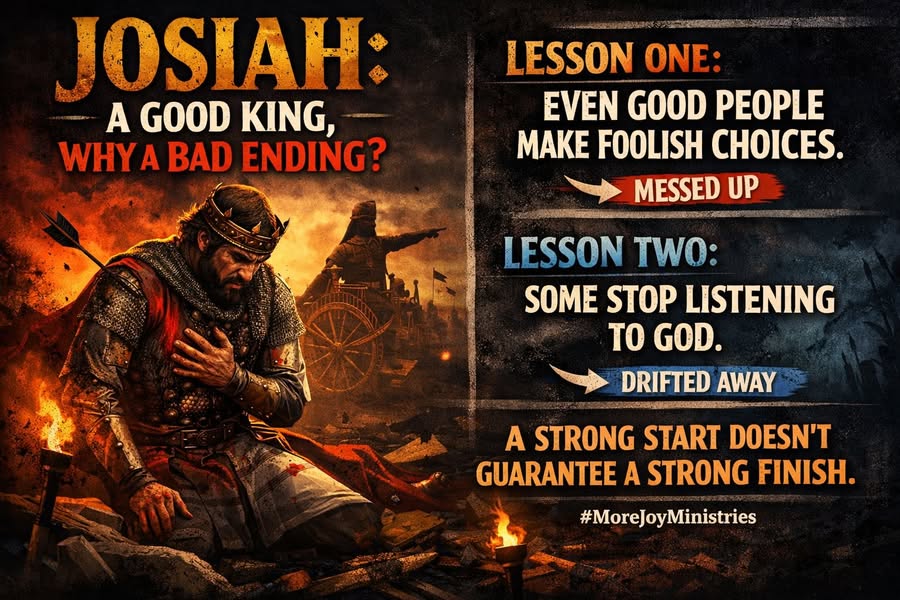
Tony Campbell added a new photo to the album: People Of The Bible.
People Of The BibleJOSIAH: A GOOD KING, SO WHY THE BAD ENDING? Josiah (Hebrew: Yoshiyahu - “Supported by Yah”) was one of the greatest kings Judah ever had. He became king at only 8 years old and ru
People Of The BibleJOSIAH: A GOOD KING, SO WHY THE BAD ENDING?
Josiah (Hebrew: Yoshiyahu - “Supported by Yah”) was one of the greatest kings Judah ever had.
He became king at only 8 years old and ruled for 31 years (640–609 BC). During his reign he accomplished one of the greatest spiritual reforms in the history of Judah.
Yet his story ends in a way that surprises many Bible readers.
He died in battle.
So how does one of Judah’s best kings end with such a tragic ending?
The Bible gives few details about Josiah’s early years as king, but in the 18th year of his reign something remarkable happened.
While repairing the Temple, the priests discovered “the Book of the Law.” Many scholars believe this was Deuteronomy, though it may have included the broader Torah.
When the Law was read to Josiah, the king was shaken.
He realized how far Judah had drifted from God’s covenant.
In repentance he tore his clothes, gathered the leaders of Judah, and renewed the covenant with the Lord.
Then Josiah launched a massive national reform.
The Temple was cleansed of idols. The symbols of Baal worship were destroyed. The worship of the “host of heaven” was removed.
Even the pagan high places scattered throughout the land were torn down.
Josiah didn’t stop inside Judah either. He pushed reforms into the former northern territories as well.
The result was one of the greatest spiritual revivals the nation had seen since the days of the Judges.
Scripture even records that the Passover celebrated under Josiah was the greatest observed in centuries.
This is especially remarkable when we remember his background.
His father Amon and grandfather Manasseh were two of the most wicked kings Judah ever had.
Yet Josiah turned completely in the opposite direction.
Because of this, the prophetess Huldah delivered a powerful message from God.
Judah would still face judgment because of earlier sin.
But Josiah himself would be “gathered to his grave in peace.” (2 Kings 22:20)
And yet… that’s not what happened.
Josiah died violently in battle.
So what went wrong?
To understand this we have to look at the political situation of the ancient world at that time.
During Josiah’s reign the great Assyrian Empire was collapsing.
The Babylonians were rising in the east.
In 612 BC Babylon destroyed the Assyrian capital of Nineveh, and the balance of power in the region began to shift.
Egypt, under Pharaoh Necho II, marched north to help the remaining Assyrian forces resist Babylon.
To reach the battlefield at Carchemish, Necho’s army had to pass through the land of Judah.
And here is where Josiah enters the story.
Pharaoh Necho sent messengers to Josiah saying:
“What have we to do with each other, O king of Judah? I am not coming against you today… God has commanded me to hurry. Stop interfering with God, who is with me, or He will destroy you.” (2 Chronicles 35:21)
That statement is fascinating.
An Egyptian pharaoh claimed God Himself had sent him on this mission.
Was it propaganda?
Possibly.
But the Bible says something surprising next.
“Josiah did not listen to what Necho had said at God’s command, but came to fight him on the plain of Megiddo.” (2 Chronicles 35:22)
Josiah disguised himself and went to battle anyway.
And the result was catastrophic.
Archers struck the king.
He was carried back to Jerusalem where he died of his wounds.
With Josiah’s death, Judah’s independence collapsed.
Pharaoh Necho installed his own puppet king, and the nation began its final slide toward Babylonian conquest.
So the question remains.
Why did such a good king make such a disastrous decision?
There are two possible lessons.
Lesson One: Even good people can make terrible mistakes.
Josiah may have still been a faithful man who simply made a tragic miscalculation.
Proverbs 26:17 warns about meddling in conflicts that do not belong to us.
Josiah inserted himself into a geopolitical struggle that did not involve Judah.
Sometimes even faithful believers make decisions that carry devastating consequences.
God does not promise to override every foolish decision we make.
You can love God deeply and still run a red light.
Lesson Two: Sometimes people stop seeking God’s guidance.
Earlier in his life Josiah clearly sought God’s will through Scripture and through God’s prophets.
But the Bible never says he sought the Lord’s counsel before confronting Pharaoh Necho.
He could have consulted the High Priest.
He could have sought prophetic guidance from Jeremiah, who was alive at that time.
But Scripture is silent.
That silence may be telling.
Even great leaders can slowly drift from the same spiritual dependence they once had.
The stories of Solomon, Josiah, and even the warning to the church in Revelation 3 remind us that spiritual decline rarely happens overnight.
It happens slowly.
Quietly.
Gradually.
We do not know which of these scenarios explains Josiah’s death.
But Scripture records these events for our instru