
Tony Campbell added a new photo to the album: People Of The Bible.
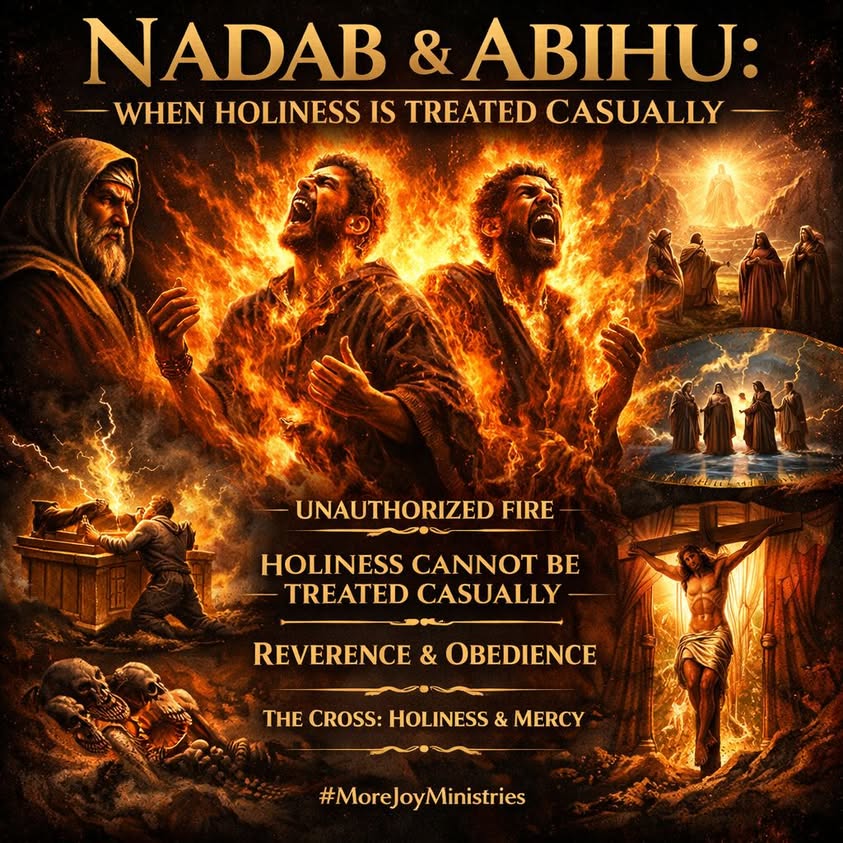
People Of The BibleNADAB AND ABIHU: (WHEN HOLINESS IS TREATED CASUALLY) One of the most sobering moments in the Old Testament happens in Leviticus chapter 10. It is a moment that reminds us that God
People Of The BibleNADAB AND ABIHU: (WHEN HOLINESS IS TREATED CASUALLY)
One of the most sobering moments in the Old Testament happens in Leviticus chapter 10. It is a moment that reminds us that God’s holiness is not symbolic, optional, or flexible. It is absolute.
Nadab and Abihu were not outsiders. They were not pagans. They were not enemies of God. They were the two oldest sons of Aaron, the first High Priest of Israel. They were ordained priests themselves, specifically chosen and anointed to serve in the tabernacle before the presence of God.
Numbers 3:2–3 records their privileged position: “The names of the sons of Aaron were Nadab the firstborn and Abihu, Eleazar and Ithamar… the anointed priests, who were ordained to serve as priests.”
These men stood closer to the presence of God than nearly anyone else in Israel.
Their spiritual resume was remarkable. Exodus 24 tells us something astonishing. Nadab and Abihu were among the leaders invited to ascend the mountain with Moses and Aaron. There they witnessed a visible manifestation of God’s glory.
“Moses and Aaron, Nadab and Abihu, and the seventy elders of Israel went up and saw the God of Israel… they saw God, and they ate and drank.” (Exodus 24:9–11)
Few humans in history have experienced such a moment. They had seen God’s power. They had witnessed His glory. They had walked in sacred responsibility.
Yet in Leviticus 10, everything changed.
“Aaron’s sons Nadab and Abihu took their censers, put fire in them and added incense; and they offered unauthorized fire before the LORD, which He had not commanded them. So fire came out from the presence of the LORD and consumed them, and they died before the LORD.” (Leviticus 10:1–2)
Scripture calls it unauthorized fire. The King James Version calls it strange fire. The Hebrew phrase is esh zarah, meaning foreign fire, fire that came from a source God did not authorize.
God had already given precise instructions that the incense used before Him must be ignited using fire taken from the brazen altar. That altar represented sacrifice, atonement, and substitution. The fire on that altar was not ordinary. It was sacred because it was tied directly to God’s system of redemption.
Nadab and Abihu ignored that instruction. Whether through carelessness, pride, impatience, or intoxication as some scholars suggest from the surrounding passage, they approached God on their own terms rather than His.
The result was immediate judgment.
Moses explains the reason in Leviticus 10:3: “Among those who approach Me I will be proved holy; in the sight of all the people I will be honored.”
God was establishing something foundational for Israel. His presence was not common. His holiness could not be treated casually. The closer someone stood to God’s presence, the greater the responsibility to honor Him correctly.
This pattern appears elsewhere in Scripture.
When King David attempted to move the Ark of the Covenant, the ark was placed on a cart rather than carried by Levites as God commanded. When the oxen stumbled, a man named Uzzah reached out to steady the ark and was struck dead instantly (1 Chronicles 13:9–10).
From a human perspective, Uzzah seemed helpful. From God’s perspective, the action violated His clearly revealed command. Sacred responsibility required sacred obedience.
These accounts often make modern readers uncomfortable. They should. They reveal a reality that many people today have forgotten. God is loving, merciful, and gracious, but He is also perfectly holy. Holiness means separation from sin, corruption, and human self-will.
The New Testament does not weaken this truth. It fulfills it through Jesus Christ.
Jesus declared: “Do not think that I have come to abolish the Law or the Prophets; I have not come to abolish them but to fulfill them.” (Matthew 5:17)
Through Christ’s sacrifice, access to God was opened. When Jesus died, the veil in the temple was torn from top to bottom, symbolizing that direct access to God was now available through Him alone (Hebrews 10:19–20).
However, access does not mean casualness. Grace is not permission to approach God carelessly. Grace is the means by which sinners are made holy through Christ’s righteousness.
First Peter 2:9 describes believers today as: “A chosen generation, a royal priesthood, a holy nation, His own special people.”
In the Old Testament, only a small group served as priests. Through Christ, every believer is now part of a royal priesthood. That privilege carries both blessing and responsibility.
The story of Nadab and Abihu teaches a timeless principle. God must be approached His way, not ours. True worship is not creativity detached from obedience. True worship is surrender to the holiness of God.
The same God who judged unauthorized fire is the God who provided the perfect sacrifice through Jesus. The cross shows both His holiness and His mercy meeting in one place.
God has not changed. His holiness has not softened. His mercy has