
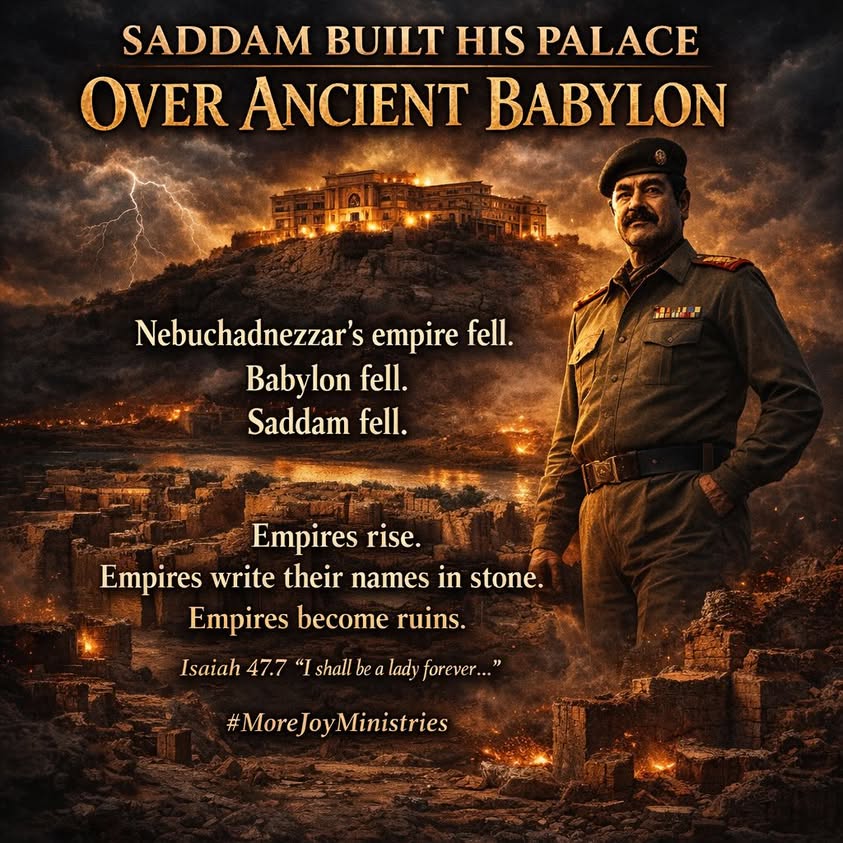
Tony Campbell added a new photo to the album: Mystery Babylon.
Mystery BabylonSADDAM HUSSEIN BUILT HIS PALACE OVER BABYLON: In the 1980s and 1990s, Saddam Hussein built a massive palace complex directly on a hill overlooking the ruins of ancient Babylon. Not be
Mystery BabylonSADDAM HUSSEIN BUILT HIS PALACE OVER BABYLON:
In the 1980s and 1990s, Saddam Hussein built a massive palace complex directly on a hill overlooking the ruins of ancient Babylon.
Not beside it.
Over it.
From the balconies of that palace, you can look down onto the remains of one of the most powerful cities in human history.
Saddam deliberately connected himself to Nebuchadnezzar II, the king who conquered Jerusalem and carried Judah into exile. Bricks in the reconstruction of Babylon were stamped with inscriptions echoing Nebuchadnezzar’s ancient formula, except now the name “Saddam Hussein” was inserted alongside it.
Ancient kings wrote their names into history through bricks and monuments.
Saddam tried to do the same.
The palace itself was enormous. Marble floors. Grand halls. Guard towers. Over 200 rooms. Positioned above the Euphrates River. It was less a residence and more a declaration:
“I am the new king of Babylon.”
But here’s what history keeps teaching.
Babylon fell.
Nebuchadnezzar’s empire fell.
The Neo-Babylonian kingdom collapsed.
And Saddam’s regime collapsed.
After 2003, the palace was looted and vandalized. Graffiti now covers walls that were once polished and guarded. The structure still stands, but it is empty. Silent. Overlooking ruins of a city that once said, “I shall be a lady forever” (Isaiah 47:7).
Empires rise.
Empires stamp their names into bricks.
Empires fall.
Babylon in Scripture represents pride, power, rebellion, and the illusion of permanence. From Genesis 11 to Revelation 17–18, the name keeps appearing as a warning: human glory does not outlast divine judgment.
- @[61583539981347:2048:More Joy Ministries]
#MoreJoyMinistriesSADDAM HUSSEIN BUILT HIS PALACE OVER BABYLON: In the 1980s and 1990s, Saddam Hussein built a massive palace complex directly on a hill overlooking the ruins of ancient Babylon. Not beside it. Over it. From the balconies of that palace, you can look down onto the remains of one of the most powerful cities in human history. Saddam deliberately connected himself to Nebuchadnezzar II, the king who conquered Jerusalem and carried Judah into exile. Bricks in the reconstruction of Babylon were stamped with inscriptions echoing Nebuchadnezzar’s ancient formula, except now the name “Saddam Hussein” was inserted alongside it. Ancient kings wrote their names into history through bricks and monuments. Saddam tried to do the same. The palace itself was enormous. Marble floors. Grand halls. Guard towers. Over 200 rooms. Positioned above the Euphrates River. It was less a residence and more a declaration: “I am the new king of Babylon.” But here’s what history keeps teaching. Babylon fell. Nebuchadnezzar’s empire fell. The Neo-Babylonian kingdom collapsed. And Saddam’s regime collapsed. After 2003, the palace was looted and vandalized. Graffiti now covers walls that were once polished and guarded. The structure still stands, but it is empty. Silent. Overlooking ruins of a city that once said, “I shall be a lady forever” (Isaiah 47:7). Empires rise. Empires stamp their names into bricks. Empires fall. Babylon in Scripture represents pride, power, rebellion, and the illusion of permanence. From Genesis 11 to Revelation 17–18, the name keeps appearing as a warning: human glory does not outlast divine judgment. - More Joy Ministries #MoreJoyMinistries Mystery BabylonSADDAM HUSSEIN BUILT HIS PALACE OVER BABYLON:
In the 1980s and 1990s, Saddam Hussein built a massive palace complex directly on a hill overlooking the ruins of ancient Babylon.
Not beside it.
Over it.
From the balconies of that palace, you can look down onto the remains of one of the most powerful cities in human history.
Saddam deliberately connected himself to Nebuchadnezzar II, the king who conquered Jerusalem and carried Judah into exile. Bricks in the reconstruction of Babylon were stamped with inscriptions echoing Nebuchadnezzar’s ancient formula, except now the name “Saddam Hussein” was inserted alongside it.
Ancient kings wrote their names into history through bricks and monuments.
Saddam tried to do the same.
The palace itself was enormous. Marble floors. Grand halls. Guard towers. Over 200 rooms. Positioned above the Euphrates River. It was less a residence and more a declaration:
“I am the new king of Babylon.”
But here’s what history keeps teaching.
Babylon fell.
Nebuchadnezzar’s empire fell.
The Neo-Babylonian kingdom collapsed.
And Saddam’s regime collapsed.
After 2003, the palace was looted and vandalized. Graffiti now covers walls that were once polished and guarded. The structure still stands, but it is empty. Silent. Overlooking ruins of a city that once said, “I shall be a lady forever” (Isaiah 47:7).
Empires rise.
Empires stamp their names into bricks.
Empires fall.
Babylon in Scripture represents pride, power, rebellion, and the illusion of permanence. From Genesis 11 to Revelation 17–18, the name keeps appearing a