
Tony Campbell added a new photo to the album: Expound - Exploratory Studies.
Expound - Exploratory StudiesMATTHEW 12:48–50 WHO IS MY MOTHER? In the Gospel of Matthew 12:48–50, Jesus responds to a message that His mother and brothers are outside asking for Him. His answer sh
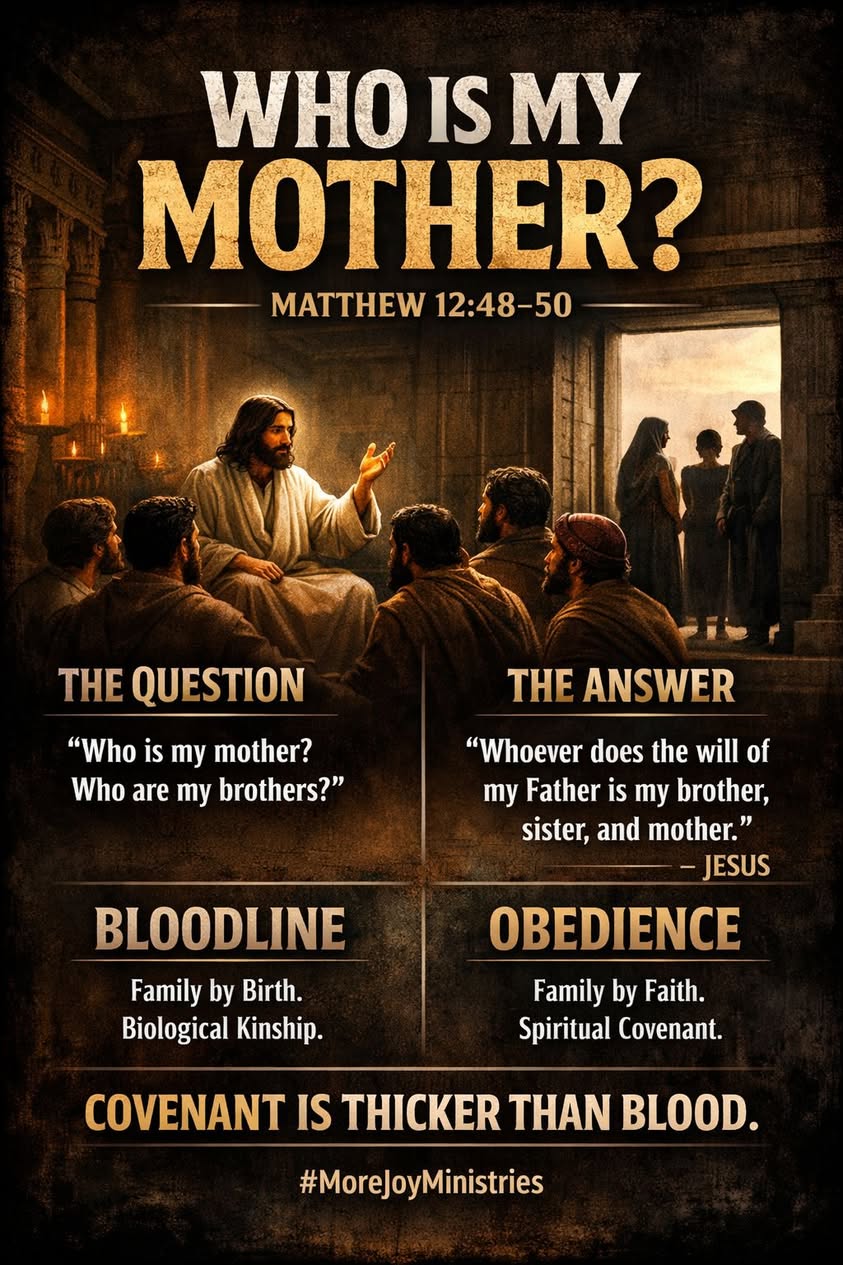
Expound - Exploratory StudiesMATTHEW 12:48–50
WHO IS MY MOTHER?
In the Gospel of Matthew 12:48–50, Jesus responds to a message that His mother and brothers are outside asking for Him.
His answer shocks the room.
“Who is my mother? and who are my brethren?” And stretching forth his hand toward his disciples, he said, “Behold my mother and my brethren. For whosoever shall do the will of my Father which is in heaven, the same is my brother, and sister, and mother.”
On the surface, it can sound dismissive. Almost cold. But that is not what is happening here.
CONTEXT MATTERS:
This moment happens in the middle of escalating opposition. Religious leaders are accusing Him of casting out demons by Beelzebub. The tension is rising. The line between belief and unbelief is becoming visible.
Then His biological family shows up.
The parallel passage in the Gospel of Mark 3:21 says His relatives thought He was “beside himself.” The Greek word there is existēmi, meaning out of His mind, unstable, mentally displaced.
So this is not a Hallmark moment. There is tension even inside His own household.
THE QUESTION:
“Who is my mother? Who are my brothers?”
The Greek word for brother is adelphos. It can mean blood brother, relative, or close associate. The word for mother is mētēr. Literal biological mother.
Jesus is not denying Mary. He is redefining identity.
He points to His disciples.
“Behold.”
That word is idou in Greek. It is an attention command. Look. See this clearly.
Then He says, “Whoever does the will of my Father.”
The Greek word for will is thelēma. It means desire, purpose, determined intention. Not casual belief. Not verbal agreement. Active alignment with the Father’s purpose.
This is covenant language.
THE SHIFT FROM BLOODLINE TO OBEDIENCE:
First century Judaism was deeply genealogical. Lineage mattered. Tribe mattered. Descent from Abraham mattered.
Jesus introduces something revolutionary.
Spiritual kinship is not determined by DNA but by obedience.
This does not dishonor family. It places covenant above biology.
Remember what He said in the Gospel of John 1:12–13:
Born not of blood, nor of the will of the flesh, nor of the will of man, but of God.
New birth overrides natural birth.
COVENANT LANGUAGE:
The Greek word for covenant throughout the New Testament is diathēkē. A binding agreement enacted by blood.
At Sinai, covenant created a nation. At the cross, covenant created a family.
When Jesus speaks here, He is previewing that reality.
The true family of God is formed by submission to the Father’s will.
This explains why later believers would call each other brother and sister across ethnic, tribal, and social boundaries. Jew and Gentile. Slave and free. Male and female.
Spiritual kinship reorders identity.
HARD TRUTH:
This passage also exposes something uncomfortable.
You can be physically close to Jesus and spiritually distant.
Mary and His brothers were outside.
The disciples were inside.
Proximity does not equal alignment.
APPLICATION:
Doing the will of the Father is not about earning salvation. It is evidence of belonging.
Obedience is not how you become family. It is how family behaves.
Jesus is not lowering the value of family. He is elevating the value of covenant faithfulness.
In a culture obsessed with biological identity, this passage reminds us that eternal identity is formed by obedience to God.
But in Scripture, covenant is thicker than blood.
- @[61583539981347:2048:More Joy Ministries]
#MoreJoyMinistriesMATTHEW 12:48–50 WHO IS MY MOTHER? In the Gospel of Matthew 12:48–50, Jesus responds to a message that His mother and brothers are outside asking for Him. His answer shocks the room. “Who is my mother? and who are my brethren?” And stretching forth his hand toward his disciples, he said, “Behold my mother and my brethren. For whosoever shall do the will of my Father which is in heaven, the same is my brother, and sister, and mother.” On the surface, it can sound dismissive. Almost cold. But that is not what is happening here. CONTEXT MATTERS: This moment happens in the middle of escalating opposition. Religious leaders are accusing Him of casting out demons by Beelzebub. The tension is rising. The line between belief and unbelief is becoming visible. Then His biological family shows up. The parallel passage in the Gospel of Mark 3:21 says His relatives thought He was “beside himself.” The Greek word there is existēmi, meaning out of His mind, unstable, mentally displaced. So this is not a Hallmark moment. There is tension even inside His own household. THE QUESTION: “Who is my mother? Who are my brothers?” The Greek word for brother is adelphos. It can mean blood brother, relative, or close associate. The word for mother is mētēr. Literal biological mother. Jesus is not denying Mary. He is redefining identity. He points to His disciples. “Behold.” That word is idou in Greek. It is an attention command. Look. See this clearly.