
Tony Campbell added a new photo to the album: End Times Alliances/Gog and Magog/Wars and Rumors.
End Times Alliances/Gog and Magog/Wars and RumorsPSALM 83: PROPHECY, PATTERN, OR FUTURE WAR? Psalm 83 is one of the most debated passages in modern prophecy discussions. Some claim it describes a com
End Times Alliances/Gog and Magog/Wars and RumorsPSALM 83: PROPHECY, PATTERN, OR FUTURE WAR?
Psalm 83 is one of the most debated passages in modern prophecy discussions. Some claim it describes a coming Middle East war. Others say it was fulfilled in ancient history. Before we speculate, we need to read it carefully.
Psalm 83 is attributed to Asaph. It is written as a prayer, not a formal prophetic oracle like those in Isaiah, Jeremiah, or Ezekiel. That distinction matters.
The psalm opens with urgency:
“O God, do not keep silence; do not hold Your peace, and do not be still, O God.”
Why?
“For behold, Your enemies make a tumult; and those who hate You have lifted up the head. They have taken crafty counsel against Your people, and consulted together against Your sheltered ones.”
Then comes the chilling objective in verse 4:
“Come, and let us cut them off from being a nation, that the name of Israel may be remembered no more.”
That is not ordinary warfare. That is eradication.
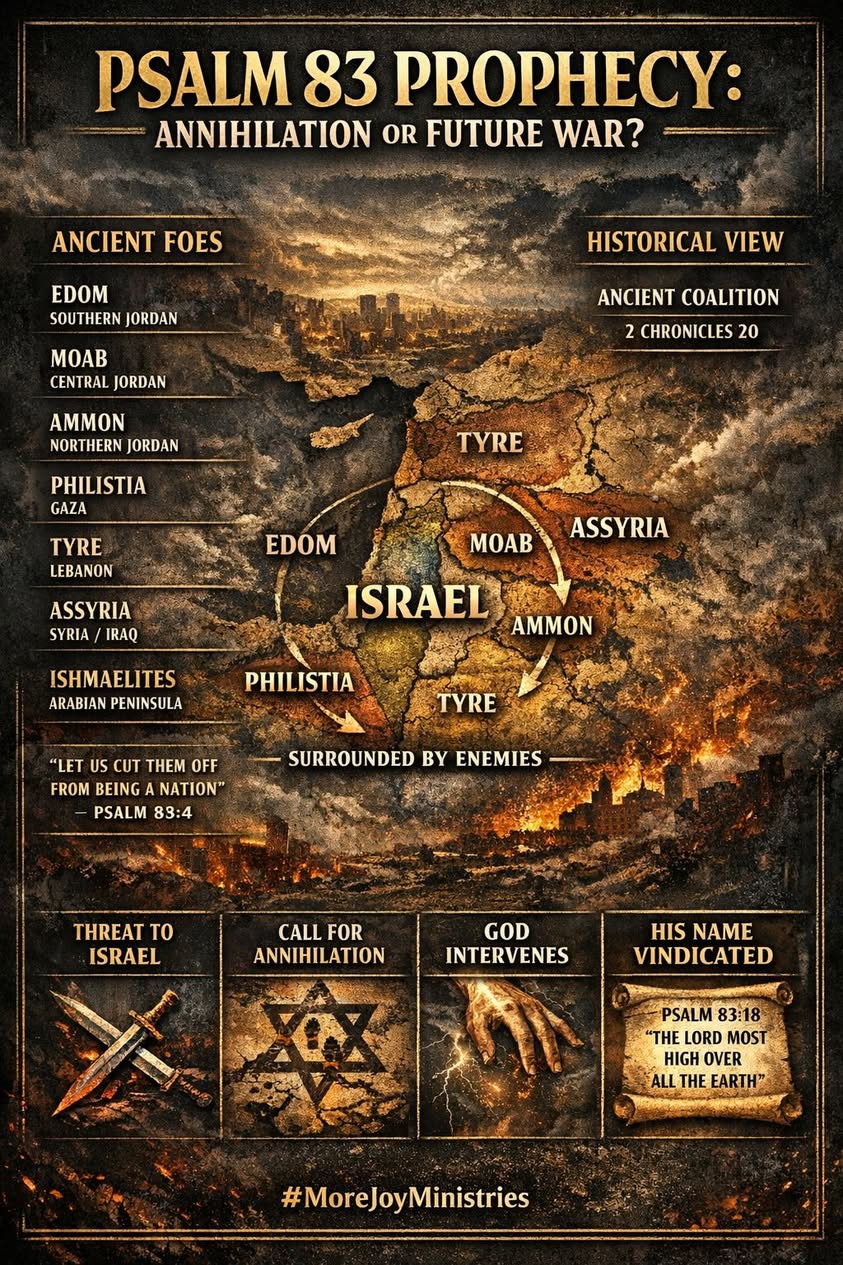
Now look at the coalition listed in verses 6–8:
The tents of Edom The Ishmaelites Moab The Hagrites Gebal Ammon Amalek Philistia The inhabitants of Tyre Assyria also is joined with them
Geographically, these represent Israel’s immediate surrounding neighbors in the ancient world. Edom, Moab, and Ammon correspond largely to modern Jordan. Philistia aligns with Gaza. Tyre is in Lebanon. Assyria covered areas of modern Syria and Iraq. The Ishmaelites connect to Arabian territories.
Notice something critical.
These are not distant superpowers from the far north. This is a ring of nations encircling Israel.
That is different from the coalition described in Ezekiel 38-39, where Gog of Magog leads a northern confederacy that includes Persia, Cush, and Put. Psalm 83 lists immediate bordering enemies. Ezekiel 38 lists more distant powers.
They are not identical lists.
So what are the options?
View One: Historical Fulfillment
Some scholars connect Psalm 83 to events like those recorded in 2 Chronicles 20, when a coalition of Moabites, Ammonites, and others came against Judah in the days of Jehoshaphat. In that case, Psalm 83 reflects a real ancient threat and God’s deliverance.
This interpretation treats the psalm as historical and complete.
View Two: A Future Regional War
Some prophecy teachers argue Psalm 83 describes a future, coordinated attempt by Israel’s surrounding neighbors to eliminate her as a nation. They note that the language “cut them off from being a nation” sounds strikingly similar to modern rhetoric from groups that openly call for Israel’s destruction.
They see it as a pre-Ezekiel 38 regional conflict that reshapes the Middle East before the larger Gog invasion.
But here is where discipline is required.
Psalm 83 never says “in the latter days.” It never places itself explicitly in the end times. It is a prayer asking God to act, not a timestamped prophecy.
We must not build timelines where the text does not.
Now look at the theological core of the psalm.
Asaph asks God to do to these enemies what He did to Midian, to Sisera, to Jabin. Those were historical defeats recorded in Judges. He is appealing to precedent.
Then verse 18 gives the purpose:
“That they may know that You, whose name alone is the LORD, are the Most High over all the earth.”
The ultimate issue is not Israel’s survival alone.
It is God’s reputation.
Throughout Scripture, attacks on Israel are framed as attacks on the covenant promises of God. The nations rage, but the deeper issue is whether God keeps His word.
Psalm 83 reveals a pattern that repeats throughout history:
Israel surrounded Israel threatened Israel targeted for elimination God intervenes
This pattern has occurred multiple times: Assyria, Babylon, Persia, Rome, Nazi Germany, and modern jihadist movements. The spirit behind “cut them off from being a nation” has not disappeared.
But here is the caution.
Not every hostile coalition equals Psalm 83 fulfilled. Not every modern alliance fits neatly into the text. Serious Bible study requires restraint.
If Psalm 83 is future, it would likely involve Israel’s immediate neighboring territories rather than distant global powers. If it is past, it still establishes a prophetic pattern that culminates in the larger conflicts described in Daniel and Ezekiel.
Either way, the message is clear.
Israel’s existence is not accidental. Her survival is not political luck. Her preservation is covenantal.
And Psalm 83 reminds us that the hatred toward Israel is ultimately spiritual before it is geopolitical.
#MoreJoyMinistriesPSALM 83: PROPHECY, PATTERN, OR FUTURE WAR? Psalm 83 is one of the most debated passages in modern prophecy discussions. Some claim it describes a coming Middle East war. Others say it was fulfilled in ancient history. Before we speculate, we need to read it carefully. Psalm 83 is attributed to Asaph. It is written as a prayer, not a formal prophetic oracle like those in Isaiah, Jeremiah, or Ezekiel. T