
Tony Campbell added a new photo to the album: Daniel.
DanielHAS DANIEL’S 70TH WEEK ALREADY BEEN FULFILLED? Some teach that Daniel’s 70th Week was fully fulfilled in the first century. While that view is popular, it does not hold up under careful, conte
DanielHAS DANIEL’S 70TH WEEK ALREADY BEEN FULFILLED?
Some teach that Daniel’s 70th Week was fully fulfilled in the first century. While that view is popular, it does not hold up under careful, contextual reading of Scripture.
Daniel was given a prophecy of 70 weeks (sevens)—a total of 490 years—specifically “determined upon thy people and upon thy holy city” (Daniel 9:24). That people is Israel, and that city is Jerusalem.
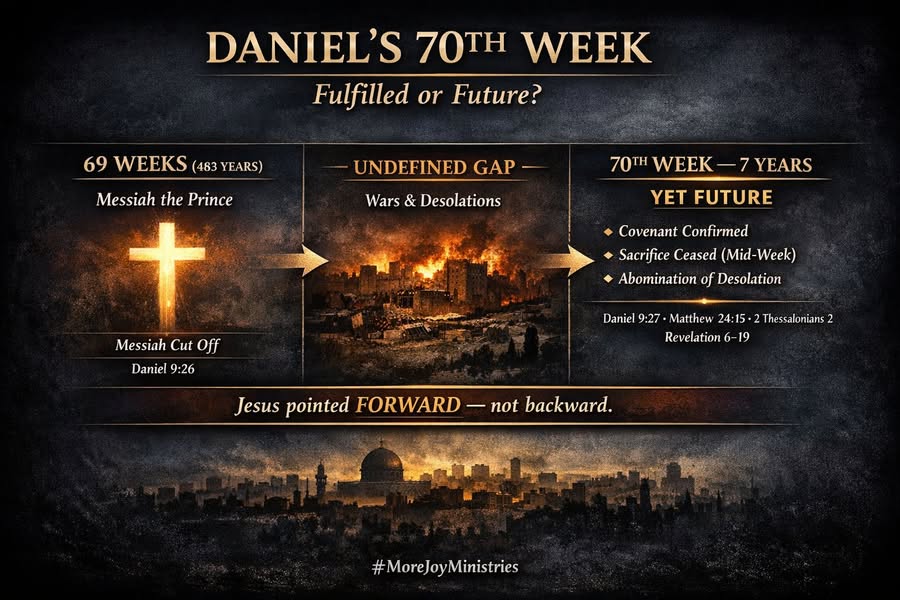
Daniel 9:25 tells us the prophetic clock begins with the decree to restore and rebuild Jerusalem and runs 69 weeks (483 years) unto Messiah the Prince. History confirms this timeline with remarkable precision.
Then Daniel 9:26 makes a critical statement: “After threescore and two weeks shall Messiah be cut off, but not for himself.” Messiah is cut off after the 69th week—but before the 70th.
That alone tells us something vital: the 70th Week does not immediately follow the 69th.
Daniel 9:26 goes on to describe the destruction of Jerusalem and the Temple, along with ongoing wars and desolations. These events occur after Messiah is cut off and before the final week begins. The gap is not inserted by theology—it is already described in the text.
Daniel 9:27 then introduces a different figure who confirms a covenant for one week, breaks it in the middle, and commits the abomination of desolation. This cannot be Jesus Christ. Jesus never made a seven-year covenant, never caused sacrifice to cease mid-week, and never committed an abomination.
In fact, Jesus Himself points forward to this event: “When ye therefore shall see the abomination of desolation, spoken of by Daniel the prophet…” (Matthew 24:15) This was spoken decades after the cross, proving Daniel’s 70th Week was still future.
Paul confirms the same future event when he describes a man who exalts himself above God, sits in the temple, and proclaims himself to be God (2 Thessalonians 2). That has never happened in history.
The book of Revelation aligns perfectly with this unfulfilled week, repeatedly referencing seven years, forty-two months, 1,260 days, a desecrated sanctuary, global persecution, and the visible return of Christ.
If Daniel’s 70th Week is already fulfilled, then Israel has no prophetic future, Jesus’ warnings lose their urgency, and Revelation becomes symbolic history.
But if the 70th Week is still future, then God’s promises to Israel stand, prophecy remains both a warning and a comfort, and believers are rightly called to watch.
“The testimony of Jesus is the spirit of prophecy.” (Revelation 19:10)
This is not about winning arguments. It is about rightly dividing the Word of truth.
- @[61583539981347:2048:More Joy Ministries] - @[100052913058244:2048:Tony Campbell]
#Daniel9 #BibleProphecy #EndTimes #WatchAndPray #ScriptureWithScripture #MoreJoyMinistriesHAS DANIEL’S 70TH WEEK ALREADY BEEN FULFILLED? Some teach that Daniel’s 70th Week was fully fulfilled in the first century. While that view is popular, it does not hold up under careful, contextual reading of Scripture. Daniel was given a prophecy of 70 weeks (sevens)—a total of 490 years—specifically “determined upon thy people and upon thy holy city” (Daniel 9:24). That people is Israel, and that city is Jerusalem. Daniel 9:25 tells us the prophetic clock begins with the decree to restore and rebuild Jerusalem and runs 69 weeks (483 years) unto Messiah the Prince. History confirms this timeline with remarkable precision. Then Daniel 9:26 makes a critical statement: “After threescore and two weeks shall Messiah be cut off, but not for himself.” Messiah is cut off after the 69th week—but before the 70th. That alone tells us something vital: the 70th Week does not immediately follow the 69th. Daniel 9:26 goes on to describe the destruction of Jerusalem and the Temple, along with ongoing wars and desolations. These events occur after Messiah is cut off and before the final week begins. The gap is not inserted by theology—it is already described in the text. Daniel 9:27 then introduces a different figure who confirms a covenant for one week, breaks it in the middle, and commits the abomination of desolation. This cannot be Jesus Christ. Jesus never made a seven-year covenant, never caused sacrifice to cease mid-week, and never committed an abomination. In fact, Jesus Himself points forward to this event: “When ye therefore shall see the abomination of desolation, spoken of by Daniel the prophet…” (Matthew 24:15) This was spoken decades after the cross, proving Daniel’s 70th Week was still future. Paul confirms the same future event when he describes a man who exalts himself above God, sits in the temple, and proclaims himself to be God (2 Thessalonians 2). That has never happened in history. The book of Revelation aligns perfectly with this unfulfilled week, repeatedly referencing seven years, forty-two months, 1,260 days, a desecrated sanctuary, global persecution, and the visible return of Christ. If Daniel’s 70th Week is already fulfilled,