
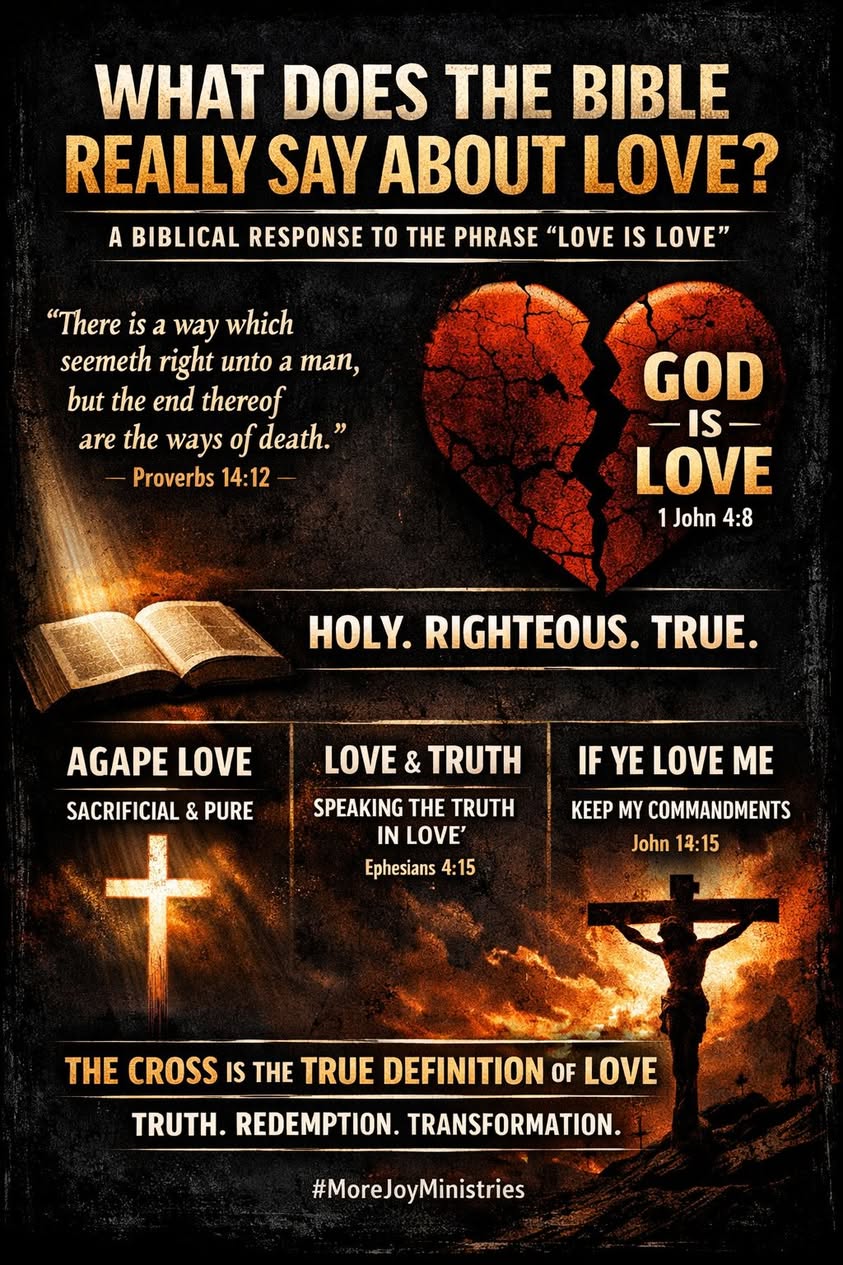
Tony Campbell added a new photo to the album: Bible Studies.
Bible StudiesWHAT DOES THE BIBLE REALLY SAY ABOUT LOVE? (A BIBLICAL RESPONSE TO THE PHRASE “LOVE IS LOVE”) Few words are used more often today than the word love. Culture, relationships, identity di
Bible StudiesWHAT DOES THE BIBLE REALLY SAY ABOUT LOVE?
(A BIBLICAL RESPONSE TO THE PHRASE “LOVE IS LOVE”)
Few words are used more often today than the word love. Culture, relationships, identity discussions, and moral debates constantly appeal to it. The phrase “love is love” has become a popular slogan meant to suggest that any expression of love is automatically good simply because it feels sincere.
At first glance, this sounds compassionate. But Scripture repeatedly teaches that sincerity alone does not determine truth or righteousness.
Proverbs 14:12 says, “There is a way which seemeth right unto a man, but the end thereof are the ways of death.”
The Bible does not reject love. Scripture elevates love as the highest virtue. But the Bible insists that love must be defined by God, not by culture, emotion, or personal desire. The real question is not whether love matters. The real question is who has the authority to define it.
The Bible teaches that God is not just loving. God is the source and definition of love itself.
1 John 4:8 says, “He that loveth not knoweth not God; for God is love.”
The Greek word used here for love is agapē (ἀγάπη). Agapē describes sacrificial, self-giving love that seeks the highest good of another person. It is not based on emotion alone. It is anchored in truth, holiness, and righteousness.
This verse does not mean love can be redefined by human feelings. It means genuine love flows from God’s character. God is holy. God is righteous. God is truthful. If something claims to be love but contradicts holiness, righteousness, or truth, Scripture teaches that it is not true love, regardless of how sincere it feels.
The Old Testament gives us another important word for love.
The Hebrew word is ahavah (אַהֲבָה). This word describes covenant loyalty, devotion, and committed relationship love. It is used to describe God’s covenant relationship with His people.
Deuteronomy 6:5 says, “And thou shalt love the LORD thy God with all thine heart, and with all thy soul, and with all thy might.”
The Hebrew word ahavah here describes faithful covenant commitment, not emotional affection alone. Biblical love is relational loyalty expressed through obedience and devotion.
The New Testament uses several Greek words for love, and understanding them is important.
Agapē (ἀγάπη) describes divine, sacrificial love.
Philia (φιλία) describes brotherly or friendship love built on affection and relationship.
Eros (ἔρως), though not used directly in the New Testament, refers to romantic or passionate love and is placed by Scripture within covenant marriage.
Modern culture often blends all forms of love together and treats them as morally interchangeable. Scripture never does this. The Bible places each form of love within moral boundaries established by God.
Scripture also teaches that love and truth are never separated.
Ephesians 4:15 says, “Speaking the truth in love…”
The Greek word for truth is alētheia (ἀλήθεια). Alētheia means reality as God reveals it. Biblical love does not affirm destructive illusions or sinful behavior. It aligns people with truth because truth produces freedom.
Jesus said in John 8:32, “Ye shall know the truth, and the truth shall make you free.”
One of the clearest definitions of love appears in 1 Corinthians 13:6, “Love rejoiceth not in iniquity, but rejoiceth in the truth.”
The Greek word translated iniquity is adikia (ἀδικία). Adikia means unrighteousness, moral injustice, or behavior that violates God’s standard. Biblical love refuses to celebrate sin. Instead, it celebrates truth because truth leads to life.
Jesus Himself gave the clearest test of love in John 14:15, “If ye love Me, keep My commandments.”
The Greek word for commandments is entolē (ἐντολή), meaning authoritative instruction or divine directive. According to Jesus, love is demonstrated through obedience to God, not independence from Him.
Scripture also teaches that love includes correction.
Hebrews 12:6 says, “For whom the Lord loveth He chasteneth…”
The Greek word translated chasten is paideuō (παιδεύω). Paideuō means to train, discipline, educate, and correct for the purpose of maturity and protection. God corrects because He loves. Correction is not hatred. Correction is protection.
Jesus perfectly balanced grace and truth. When He spoke to the woman caught in adultery, He said, “Neither do I condemn thee: go, and sin no more.” (John 8:11)
Jesus showed mercy, but He never redefined sin as righteousness. He rescued people from sin because He loved them too much to leave them in it.
The cross is the greatest definition of love ever given.
Romans 5:8 says, “But God commendeth His love toward us, in that, while we were yet sinners, Christ died for us.”
The cross shows that love acknowledges sin exists. Love pays the price for redemption. Love seeks transformation, not just affirmation.
Culture often teaches that love is self-expression. Scripture teaches that love is God-ex