
Tony Campbell added a new photo to the album: Parables.
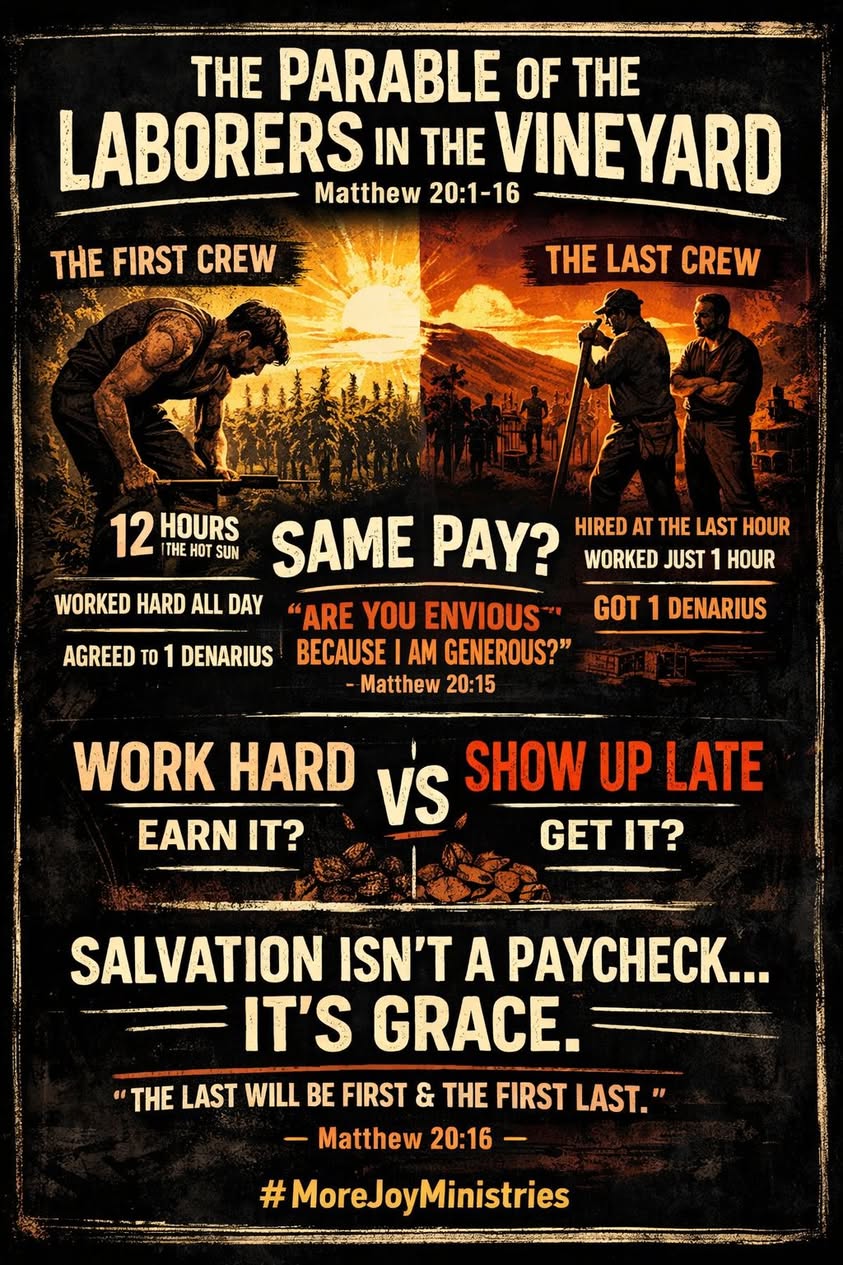
ParablesTHE PARABLE OF THE LABORERS IN THE VINEYARD: (Matthew 20:1–16) I’ve always thought this parable hits a nerve because it touches something we all understand. Work. Anyone who has worked a l
ParablesTHE PARABLE OF THE LABORERS IN THE VINEYARD:
(Matthew 20:1–16)
I’ve always thought this parable hits a nerve because it touches something we all understand.
Work.
Anyone who has worked a long, hard day knows exactly how this feels.
You’re out there early. Sun barely up. You’re carrying the weight, doing the heavy lifting, pushing through the heat while others aren’t even awake yet. By the end of the day your back is sore, your clothes are soaked, and you’ve earned every dollar you’re about to be paid.
Now imagine a guy who shows up for the last hour.
And he gets paid the same as you.
That’s the tension Jesus intentionally builds in this story.
The whole conversation starts because Peter asks Jesus a direct question. In Matthew 19:27 he says,
“We have left everything to follow you. What then will we have?”
Peter wasn’t being arrogant. He was being honest. The disciples had walked away from careers, families, and stability to follow Christ. They wanted to know what the reward would be.
So Jesus answers with a parable.
He says the kingdom of heaven is like a landowner who goes out early in the morning to hire workers for his vineyard.
In the ancient world this was a normal scene. Day laborers gathered in the marketplace hoping someone would hire them. If they didn’t get work that day, their family might not eat.
The landowner hires the first group at sunrise and agrees to pay them one denarius, the standard wage for a full day of hard labor.
Fair deal.
They go to work.
But then the landowner keeps going back to the marketplace.
He hires more workers at nine in the morning.
More at noon.
More at three in the afternoon.
And finally, at five in the evening, when there’s only about an hour left in the workday, he hires another group.
When evening comes, it’s time to pay everyone.
The landowner does something interesting. He tells the foreman to start paying the workers beginning with the ones hired last.
The guys who worked one hour step forward.
They get a full denarius.
A full day’s wage.
The men who had been working since sunrise see this and start thinking, Alright… if they got that much, we’re about to get a lot more.
But when their turn comes, they receive the exact same thing.
One denarius.
Exactly what they agreed to.
And now they’re angry.
They say, “These men worked one hour, and you made them equal to us who carried the burden of the day and the scorching heat.”
You can almost hear the frustration in their voices.
Because in our world, effort equals reward. Work harder, get more. That’s the system we understand.
But the landowner answers them with a question that cuts straight to the heart of the issue.
“Friend, I am doing you no wrong. Did you not agree with me for a denarius? Take what belongs to you and go. I choose to give to this last worker the same as I give to you. Am I not allowed to do what I want with what belongs to me? Or is your eye evil because I am good?”
That phrase “evil eye” was a Hebrew expression for jealousy.
In other words, the problem wasn’t injustice.
The problem was resentment.
And this is where the parable gets real.
Because if we’re honest, the world today has the same divide you see in that vineyard.
You’ve got people who wake up early, work hard, carry responsibility, and push through the heat of the day.
And you’ve got people who show up late… or barely show up at all.
Strong men carry the load.
Lazy men complain about the pay.
But Jesus isn’t giving a lesson about labor economics.
He’s revealing how the kingdom of God actually works.
Some people come to Christ early in life.
They walk with Him for decades. They serve, sacrifice, and carry the load for years.
Others come late.
Some people spend half their life running the other direction before they finally turn around.
Some come to Christ in their forties.
Some in their seventies.
Some in the final moments of their life.
Think about the thief on the cross.
One moment he’s a condemned criminal.
Minutes later Jesus tells him, “Today you will be with me in paradise.”
From a human perspective that feels upside down.
But salvation isn’t a paycheck.
It’s grace.
None of us earned it.
Romans 3:23 says all have sinned and fall short of the glory of God. No one shows up in the vineyard with perfect credentials.
We are there because the Owner came looking for us.
That’s why Paul writes in Romans 9:15,
“I will have mercy on whom I have mercy.”
The men who complained in the story were acting like the Pharisees in Jesus’ day. They believed their religious effort made them more deserving of the kingdom than the sinners Jesus welcomed.
But grace destroys that idea.
Grace levels the ground.
The man who walks with Christ for sixty years and the man who repents in his final hour both receive the same eternal life.
Not because they worked the same.
But because salvation was never wages in the first place.
Jesus closes the story with the line:
“So the last will