
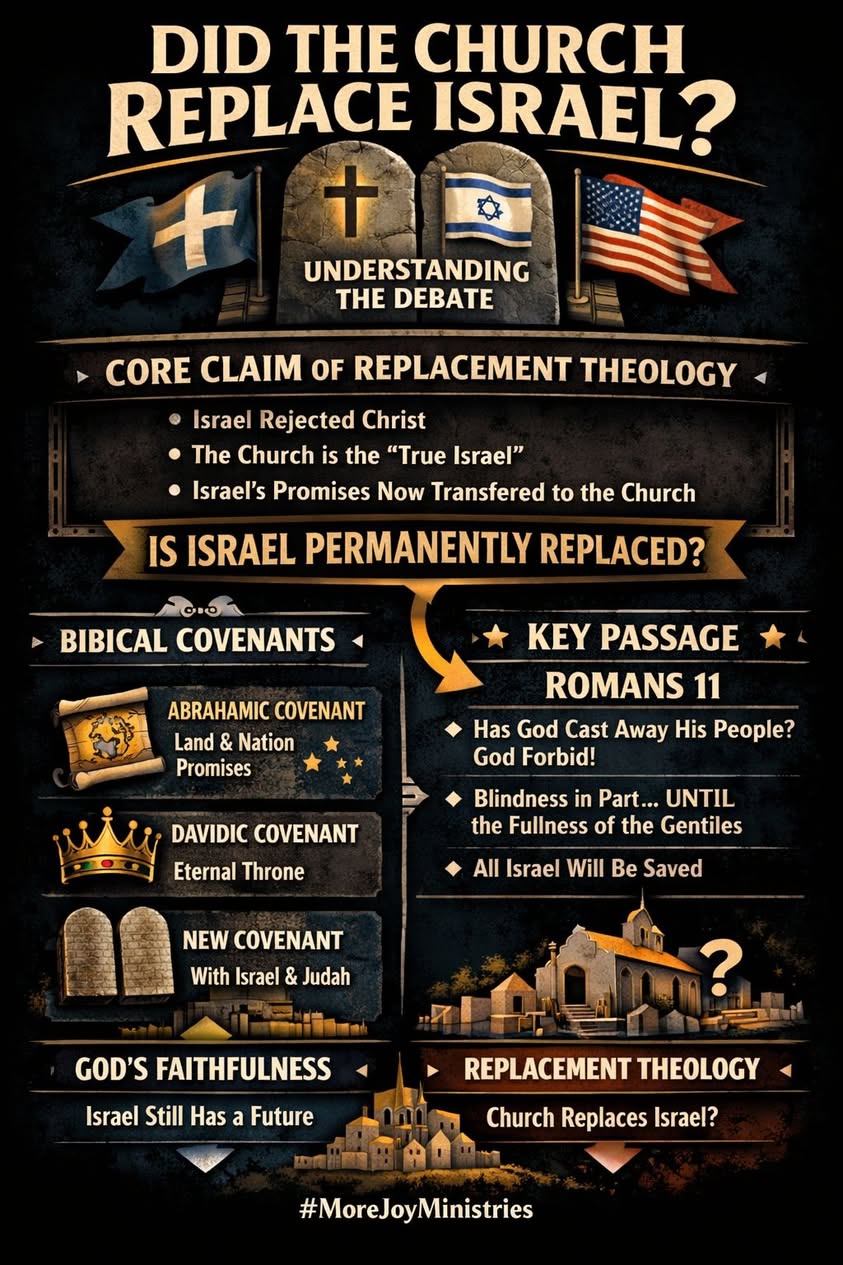
Tony Campbell added a new photo to the album: Covenants.
CovenantsREPLACEMENT THEOLOGY: DID THE CHURCH REPLACE ISRAEL? This topic matters because it changes how you read almost every major prophecy passage in the Bible. It affects how you interpret Daniel,
CovenantsREPLACEMENT THEOLOGY: DID THE CHURCH REPLACE ISRAEL?
This topic matters because it changes how you read almost every major prophecy passage in the Bible. It affects how you interpret Daniel, Zechariah, Matthew 24, Romans 11, Revelation, and the very meaning of covenant faithfulness. If you get Israel wrong, you will almost always get the end times wrong.
Replacement theology is often called supersessionism. The core claim is simple: national Israel no longer has a distinct covenant future because the Church has taken Israel’s place. In other words, Israel’s promises are either canceled, transferred, or reinterpreted spiritually so that the Church becomes “the true Israel” in every sense.
This is not the question of whether Gentiles can be saved. They absolutely can. This is not the question of whether there is one way of salvation. There is only one: by grace through faith in Jesus Christ. This is not the question of whether the Church shares in spiritual blessings. It does.
The real question is this: did God revoke His national covenant promises to Israel, or do those promises still stand and will be fulfilled as written?
If Scripture teaches that God permanently cast off Israel as a nation, then replacement theology is correct. But if Scripture teaches that Israel’s hardening is temporary and that God’s covenant promises remain intact, then replacement theology collapses.
So let Scripture speak.
THE FOUNDATION: GOD’S COVENANTS ARE NOT A SMALL DETAIL
To understand this issue, you have to understand how the Bible treats covenant. God does not speak casually when He makes covenant. He binds His name to His word. If God makes unconditional promises to Israel, then the only way replacement theology can be true is if God breaks His covenant word or redefines it after the fact.
Now watch how the Old Testament sets this up.
THE ABRAHAMIC COVENANT: WHO WALKED THROUGH THE PIECES?
Genesis 12 begins the promises. Genesis 15 seals them.
In Genesis 15, God tells Abram to prepare animals, cut them, and lay the pieces opposite one another. In the ancient world, this was covenant language. The idea was: may I become like these slain animals if I break this covenant.
But here is the key: Abram does not walk through the pieces. God does.
Genesis 15 describes a smoking furnace and a burning lamp passing between the pieces. Abram is in a deep sleep. God is the One who binds Himself to fulfill the covenant.
That means the Abrahamic covenant is not dependent on Israel’s performance for its ultimate fulfillment. It is rooted in God’s faithfulness.
And what exactly is promised?
A specific land with boundaries. A literal nation from Abraham’s seed. A global blessing through Abraham’s seed.
So immediately we learn something. The Bible does not treat Israel as a vague symbol. It treats Israel as a real people group with real promises anchored in covenant.
THE LAND PROMISE DOES NOT DISAPPEAR AFTER DISOBEDIENCE:
One of the strongest passages is Deuteronomy 30.
Moses predicts Israel’s future failure, scattering, and exile. Then God says He will restore them.
Deuteronomy 30:1–5 teaches regathering language from the nations back into the land. This is national language. It is geographic language. It is not describing “going to heaven.” It is describing God bringing Israel back.
So even after God predicts their disobedience, He still speaks of future restoration.
THE DAVIDIC COVENANT: A THRONE, A KINGDOM, A FOREVER PROMISE
In 2 Samuel 7:12–16, God promises David a dynasty and an eternal throne.
This covenant is not just “a spiritual reign in hearts.” The language is kingship, throne, kingdom, and duration.
And the New Testament explicitly connects Jesus to this promise.
Luke 1:32–33 says Jesus will receive “the throne of His father David” and will reign over “the house of Jacob” forever. That is covenant language. That is Israel language. That is kingdom language.
THE NEW COVENANT: “WITH THE HOUSE OF ISRAEL AND THE HOUSE OF JUDAH”
Jeremiah 31:31–37 is the knockout passage that replacement theology struggles to survive.
God says He will make a new covenant “with the house of Israel and with the house of Judah.” He then describes national forgiveness, internal transformation, and covenant permanence.
Then God makes this argument: only if the fixed order of the sun, moon, and stars can be removed will Israel cease from being a nation before Him.
That is not ambiguous. God anchors Israel’s continued national identity to the stability of creation.
If replacement theology says Israel is no longer a nation before God in covenant terms, then Jeremiah 31 has to be reinterpreted away from its plain meaning.
Now let’s move into the New Testament because this is where the whole debate gets decided.
THE KEY NEW TESTAMENT PASSAGE: ROMANS 9–11
Romans 9–11 is not an optional side discussion. It is Paul’s direct answer to the question: If Israel rejected Messiah, did God’s word fail? Did God cast them off? Are